Cademix Institute of Technology, Vienna, Austria | +43 650 967 7080 | info@cademix.org

Estimated Reading Time: 6 minutes
Sanju Cherian From CAD to FEA

How to become a FEA Simulation Engineer from a CAD Design Engineer

By Sanju Cherian

 The industry requires Finite Element Analysis Experts more than ever. This article compares the skills sets and describes the pathway how to become a FEA Simulation from a CAD Design Engineer. It is the powerful approach to perform What-if experiments.

INTRODUCTION

 The industry requires Finite Element Analysis Experts more than ever. This article compared the skills sets and describes the pathway how to become a FEA Simulation from a CAD Design Engineer. 

Finite Element Analysis (FEA) is a computer-aided engineering (CAE) tool used to analyze how a design reacts under real-world conditions. It is also known as a very powerful approach to perform What-if experiments. Useful in structural, vibration, and thermal analysis, FEA has been widely implemented by automotive companies. It’s used by design engineers as a design tool during the product development process because it allows them to analyse their own designs while they are still in the form of easily modifiable CAD models, providing quick turnaround times and ensuring prompt implementation of analysis results in the design process. While FEA software is readily available, successful use of FEA as a design tool still requires an understanding of FEA basics, familiarity with the FEA process and commonly used modeling techniques, and an appreciation of inherent errors and their effect on the quality of results. When used properly, the FEA becomes a tremendous productivity tool, helping design engineers reduce product development time and cost.


Computer Aided Design (CAD) is an important skill in today’s world. It has many real world applications, from building cars to modelling construction sites. CAD is a high-earning career path with attractive remuneration whilst offering the chance of artistic expression. A good CAD designer is continuously learning and improving their skills and will always find ways to challenge themselves. A CAD system plays a major role in how products are designed. How well you are able to manage and implement your own CAD system has a large impact on your company’s overall productivity and success.

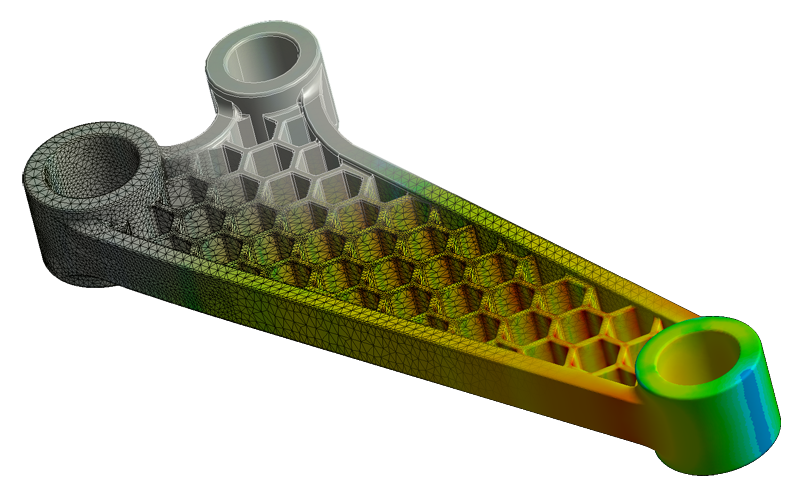
Finite Element Analysis Honeycomb lightweight

PRINCIPLES OF FEA

Finite Element method is generally used in FEA to compute approximate solutions of boundary problems (field problems) in engineering. “Field variables” are the variables of interest that are governed by a differential equation. They must achieve a boundary condition for specific values of the variables (or related variables). A “node” is a specific point on the finite element that contains the value of the field variable — that is normally explicitly calculated. These values are then used to compute values at non-nodal points through interpolation of values at the nodes using shape functions.


APPLICATION OF FEA IN CAD

FEA is among the most powerful and commonly used features in CAD design.

It is integral to CAD for analyzing an object through the use of finite elements that include small rectangular and triangular shapes. To analyze the whole object, each finite element in the whole object network is analyzed, and the outcomes are combined to plot the overall behavior of a complex object. Each element can be analyzed for certain property thresholds like stress-strain, dynamics, thermal properties — or any other characteristics (depending on where it is applied).

In a CAD workflow, you can define each element and network structure as you require in your design.

Key features of a good FEA Simulation Engineer and a CAD Design Engineer

CONCLUSION

FEA allows engineers to conduct the simulation of a designed model rather than having to create a physical model for testing purposes. FEM during analysis allows modeling of a diverse number of material types, and the ability to monitor how confined effects impact a small area of design in complicated geometry. Fluid dynamics, deformation of a vehicle from collision and stress on human bones are some of the practical utilization of finite element modeling software by engineers. A CAD Engineer learning these key attributes will make them a successful FEM Simulation Engineer having the skills of both Design and Simulation helping organisations to create better and sustainable products.


References

  • Developing Expert CAD Systems by V. Begg
  • Finite Element Analysis (FEA) for Design Engineers by Dr. Paul Kurowski
  • Sub-modeling finite element analysis of 3D printed structures
    J Zarbakhsh, et. al. Multi-Physics Simulation IEEE 2015

Related Topics

People also visited:

Navigating the Optometrist Career: A Pathway to Vision Health and Professional Fulfillment

Evaluating EU-Funded Quantum Photonics Projects: Policy, Strategy, and Skill-Building Initiatives

AI-Assisted Parametric Design: The Future of Architecture and Product Development

From Sketch to Prototype: Transforming Your Ideas with TinkerCAD

200 Interview Questions for Germany and Austria

Authorship Privacy Policy at Cademix: A Balance of Anonymity and Accountability

Eyeglass Lens Replacement: A Comprehensive Guide to Benefits, Types, and Considerations

Understanding Engagement: A Psychological Perspective on Disruptive Social Media Content

A Game Theory Model of Opportunism Behavior in Auctions

Inclusive Workforce Strategies: Barriers to Preparing Graduates for Diverse and Aging Workforces

Applications of Heterogeneous Catalysis in Industry

Improving Communication Skills with GPT-4o: Applications for Real-Time Personal and Professional Gro...

Discreet Censorship Approach to Maintaining a Healthy Social Media Community

Innovating for a Sustainable, Eco-Friendly Design Revolution

KI-gestütztes SEO: Nutzung künstlicher Intelligenz für optimale Suchmaschinenleistung

Comprehensive Guide to Curriculum Vitae Format PDF: How to Create, Customize, and Use Professional C...

Elektrochemische Biosensoren: Eine Revolution für Point-of-Care-Diagnostik – Ein Überblick

Efficient Resource Management in Handling Client Inquiries

Streamlining the Recruitment Process with Chat-GPT: A Guide for HR Professionals

RX Safety Glasses: Protecting Your Vision with Style and Function

How to create animation in Matlab?

Renovierung eines Bestandsgebäudes – Erfahrungsbericht aus Planung und Umsetzung in 2025

Why Europe is very attractive destination for highly skilled workers and international tech graduate...

Estimated Reading Time: 6 minutes
Sanju Cherian From CAD to FEA

How to become a FEA Simulation Engineer from a CAD Design Engineer

By Sanju Cherian

 The industry requires Finite Element Analysis Experts more than ever. This article compares the skills sets and describes the pathway how to become a FEA Simulation from a CAD Design Engineer. It is the powerful approach to perform What-if experiments.

INTRODUCTION

 The industry requires Finite Element Analysis Experts more than ever. This article compared the skills sets and describes the pathway how to become a FEA Simulation from a CAD Design Engineer. 

Finite Element Analysis (FEA) is a computer-aided engineering (CAE) tool used to analyze how a design reacts under real-world conditions. It is also known as a very powerful approach to perform What-if experiments. Useful in structural, vibration, and thermal analysis, FEA has been widely implemented by automotive companies. It’s used by design engineers as a design tool during the product development process because it allows them to analyse their own designs while they are still in the form of easily modifiable CAD models, providing quick turnaround times and ensuring prompt implementation of analysis results in the design process. While FEA software is readily available, successful use of FEA as a design tool still requires an understanding of FEA basics, familiarity with the FEA process and commonly used modeling techniques, and an appreciation of inherent errors and their effect on the quality of results. When used properly, the FEA becomes a tremendous productivity tool, helping design engineers reduce product development time and cost.


Computer Aided Design (CAD) is an important skill in today’s world. It has many real world applications, from building cars to modelling construction sites. CAD is a high-earning career path with attractive remuneration whilst offering the chance of artistic expression. A good CAD designer is continuously learning and improving their skills and will always find ways to challenge themselves. A CAD system plays a major role in how products are designed. How well you are able to manage and implement your own CAD system has a large impact on your company’s overall productivity and success.

Finite Element Analysis Honeycomb lightweight

PRINCIPLES OF FEA

Finite Element method is generally used in FEA to compute approximate solutions of boundary problems (field problems) in engineering. “Field variables” are the variables of interest that are governed by a differential equation. They must achieve a boundary condition for specific values of the variables (or related variables). A “node” is a specific point on the finite element that contains the value of the field variable — that is normally explicitly calculated. These values are then used to compute values at non-nodal points through interpolation of values at the nodes using shape functions.


APPLICATION OF FEA IN CAD

FEA is among the most powerful and commonly used features in CAD design.

It is integral to CAD for analyzing an object through the use of finite elements that include small rectangular and triangular shapes. To analyze the whole object, each finite element in the whole object network is analyzed, and the outcomes are combined to plot the overall behavior of a complex object. Each element can be analyzed for certain property thresholds like stress-strain, dynamics, thermal properties — or any other characteristics (depending on where it is applied).

In a CAD workflow, you can define each element and network structure as you require in your design.

Key features of a good FEA Simulation Engineer and a CAD Design Engineer

CONCLUSION

FEA allows engineers to conduct the simulation of a designed model rather than having to create a physical model for testing purposes. FEM during analysis allows modeling of a diverse number of material types, and the ability to monitor how confined effects impact a small area of design in complicated geometry. Fluid dynamics, deformation of a vehicle from collision and stress on human bones are some of the practical utilization of finite element modeling software by engineers. A CAD Engineer learning these key attributes will make them a successful FEM Simulation Engineer having the skills of both Design and Simulation helping organisations to create better and sustainable products.


References

  • Developing Expert CAD Systems by V. Begg
  • Finite Element Analysis (FEA) for Design Engineers by Dr. Paul Kurowski
  • Sub-modeling finite element analysis of 3D printed structures
    J Zarbakhsh, et. al. Multi-Physics Simulation IEEE 2015

Related Topics

People also visited:

Prescription Contacts: Choosing the Best Options in Europe

Nanorobots: A Tiny Robot For Diagnosis And Treatment

Superabsorbent Polymer – A Review

Advanced SEO Techniques: Leveraging Reflective Search Intent for Competitive Edge

How to manage your profession like a business

SEO-Optimierung für mehrsprachige Websites: Ein umfassender Leitfaden

How to Become an Optometrist: A Comprehensive Guide for Job Seekers

Criticism in European Business Culture

Comprehensive Guide to the German Job Seeker Visa: How to Apply, Eligibility, and Tips for Success

Revolutionizing Logo Design: The Creative Power of AI

Why PhDs Struggle to Adapt to Industry? Organizational Psychology in Transition

Agility Within a Non-Agile Environment

Refractometry: Essential Tool in Optometry

Exploring Career Opportunities in Locum Optometrist Jobs

Leveraging GPT and AI for Career Coaching and Professional Development

Freelance Architect Job, Design and Make Money

Challenges in 3D Medical Imaging Reconstruction: Factors and Considerations

Biofinity Toric: A Comprehensive Guide to Comfort and Clear Vision for Astigmatism

Speak Simply, Write Accurately: Interview Preparation Guide for Non-Native Speakers

Colored Eye Contacts: A Fun Guide for Kids to Understand and Use Safely

Understanding Your Eyeglass Prescription: A Comprehensive Guide

Psychological Factors in Digital Marketing: How Social Media Influences Purchasing Decisions

The User Research Role in Shaping User-Centric Mobile Apps

Effective Multi-Platform Communication: Integrating Email, WhatsApp, and Other Messaging Platforms

Shopping Basket