
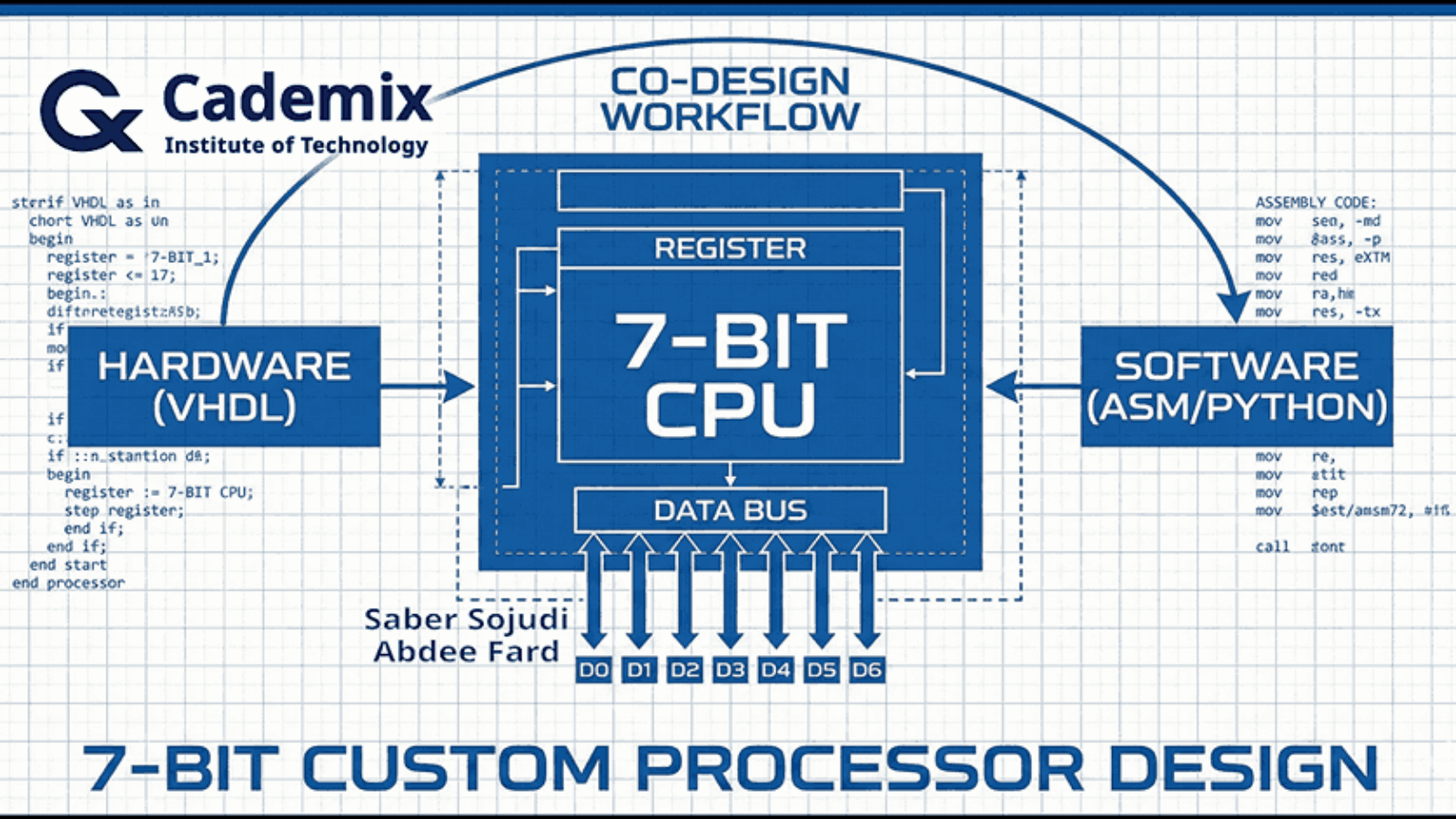
Blueprint-style overview of the 7-bit processor co-design workflow linking VHDL hardware, ASM/Python software, and the CPU datapath

A Practical 7-Bit Processor with a Python Assembler

Estimated Reading Time: 16 minutes

I built a compact 7-bit processor to explore hardware–software co-design end-to-end: defining a minimal instruction set, implementing the datapath and control in VHDL, and closing the loop with a small assembler that produces ROM-ready binaries. The design focuses on a small core of operations LOAD, ADD, SUB, and JNZ with an extended MULTIPLY instruction implemented using a shift-and-add approach to keep the hardware simple. Internally, the processor is decomposed into familiar blocks (ALU, register file, program counter, instruction register, ROM, and multiplexers), with a control unit described as an ASM-style state machine that sequences fetch, decode, and execute. A four-register file (R0–R3) and a zero flag provide the minimum state and condition mechanism needed for basic control flow. To integrate software with the hardware model, I use a Python-based assembler that converts assembly-like inputs into the binary encodings expected by ROM initialization. The project is intended to be validated in simulation by observing program counter progression, register updates, and ALU outputs under representative instruction sequences.
Saber Sojudi Abdee Fard

Introduction

I designed this project to practice hardware–software co-design in a setting small enough to reason about completely. The core idea is straightforward: define a minimal instruction set, implement a complete processor around that ISA in VHDL, and connect it to a simple software tool a Python assembler that produces the exact 7-bit encodings the hardware expects. The result is an offline simulation workflow where I can iterate on both sides of the boundary: instruction semantics in hardware and program encoding in software.

The processor is intentionally constrained. Both data and instruction representations are 7 bits wide, and the ISA is limited to a small set of operations: LOAD, ADD, SUB, JNZ, and an extended MULTIPLY. Memory is ROM-based, and the goal is correctness and clarity in simulation rather than breadth of CPU features or performance. Within that scope, the design targets a complete “compile -> encode -> load -> simulate -> inspect” loop: compiling and simulating the VHDL modules, translating an assembly-like program through Conversion.py, loading the produced binary into Memory.vhd, and then validating behavior by inspecting the program counter, register updates, and ALU outputs in the simulator.

This article explains the system the way I worked with it: as a set of contracts between modules and between software and hardware. I focus on the architectural decomposition (datapath and control), the encoding boundary enforced by the assembler, and what constitutes a successful run in simulation. I also call out the explicit non-goals such as advanced control-flow features, richer memory models, or microarchitectural optimizations because the constraints are part of what makes the design teachable.

Methodology

Architecture overview

I implemented the processor as a small set of composable VHDL building blocks connected around a single 7-bit internal bus. The top-level entity (Processor) exposes CLK and RESET inputs and exports the four general-purpose register values (R0out–R3out) specifically to make simulation inspection straightforward.

Inside Processor.vhd, the datapath is wired as follows:

  • A ROM (Memory) outputs a 7-bit word (MData) addressed by the program counter output (PC_OUT).
  • Two 4-to-1 multiplexers (MUX4x1) select ALU operands from the four register outputs (ROUT0–ROUT3). Each mux is driven by a 2-bit selector (S0 for operand A, S1 for operand B).
  • The ALU computes a 7-bit result (ALURes) based on a 2-bit command (CMD).
  • A 2-to-1 “bus mux” (MUX2x1) selects what drives the shared internal bus (BUSout): either ROM data (MData) or the ALU result (ALURes), controlled by BUS_Sel.
  • The shared bus is then assigned to a single internal input (RIN <= BUSout) that feeds every state-holding element: the four registers, the instruction register (IR), and the program counter (PC) load their next value from RIN when their respective load control is asserted.

This wiring creates a clean contract boundary: computation happens in the ALU, storage happens in registers/IR/PC, and the only way values move is by selecting a source onto the bus and latching it into a destination on the next clock edge.

A control unit (control_unit) sits beside the datapath. It consumes the current instruction (ROUTIR, the instruction register output) and per-register zero indicators (ZR0–ZR3), and it drives all load/select signals: LD0–LD3, LDIR, LDPC, INC, BUS_Sel, plus the ALU command (CMD) and the two operand selectors (Sel0, Sel1).
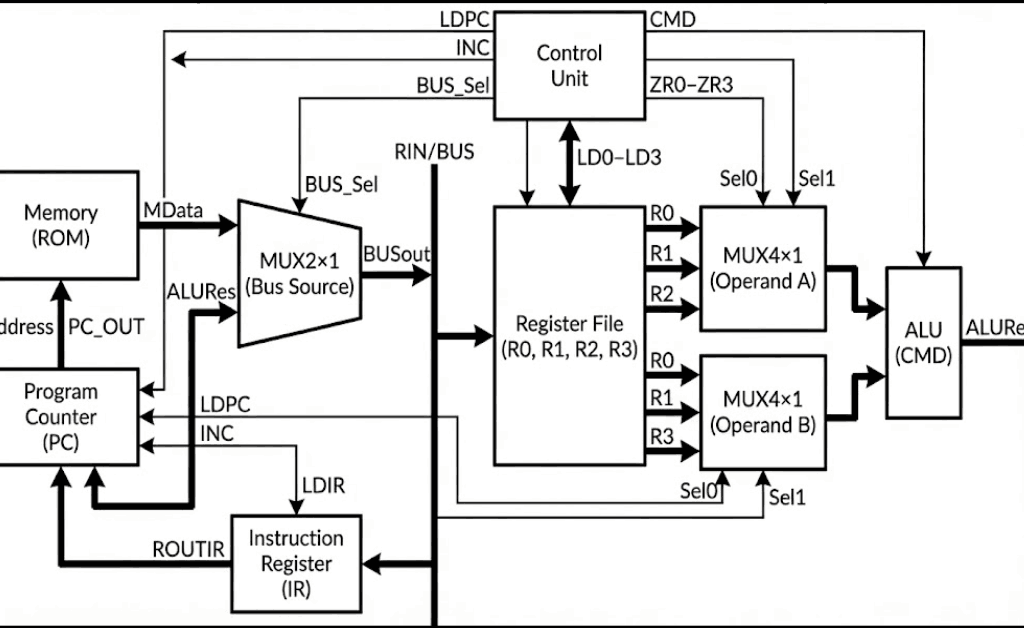
Block diagram of the 7-bit CPU showing ROM, PC, shared RIN/BUS, register file, operand muxes, ALU, and control-unit signals

Figure 1 — The ROM, register file, and ALU are connected through a single bus-source mux that drives a shared internal bus (RIN), while the control unit sequences selects and load-enables for fetch and execute.

Control unit and instruction sequencing

I implemented the controller as an explicit enumerated-state machine in control_unit.vhd. The control unit decodes two fields from the 7-bit instruction:

  • y <= ROUTIR(6 downto 4) as a 3-bit opcode.
  • x <= ROUTIR(3 downto 2) as a 2-bit register selector (converted to an integer Reg_num for indexing the zero-flag vector).

The control flow uses these states (as defined in the state type): S0, S1, D, S2, S3, S4, S5, S6, S7, and S8. Operationally, they map to a compact fetch–decode–execute loop:

  • Fetch (S0): the controller asserts LDIR <= 1 while selecting ROM data onto the bus (BUS_Sel <= 0). In the same state it asserts INC <= 1 to advance the PC. Conceptually, this state is responsible for “IR <- M[PC]” and “PC <- PC + 1”.
  • Stabilize (S1): the controller deasserts INC and LDIR and transitions to decode.
  • Decode (D): the controller either halts, dispatches to an execute state based on y, or evaluates a conditional branch using the selected register’s zero flag.
    • A literal all-ones instruction (ROUTIR = "1111111") is treated as halt and transitions into S2, which self-loops.
    • If y = "000", it dispatches to Load (S3).
    • If y = "001", it dispatches to Add (S4).
    • If y = "010", it dispatches to Sub (S5).
    • If y = "100", it dispatches to Multiply (S8).
    • Otherwise, it treats the instruction as a conditional PC control operation that consults ZR(Reg_num) and chooses between S6 (load the PC) and S7 (skip).

The execute states drive the datapath in a very direct way:

  • Load (S3) asserts exactly one of LD0–LD3 based on x, keeps the bus sourcing from ROM (BUS_Sel <= 0), and asserts INC <= 1 before returning to fetch. This matches a “load immediate/data word from ROM and step past it” pattern.
  • Add/Sub/Multiply (S4, S5, S8) select registers into the two ALU operand muxes (Sel0, Sel1), set CMD to the operation code ("00" for add, "01" for sub, "10" for multiply), switch the bus to the ALU result (BUS_Sel <= 1), and assert one of LD0–LD3 to latch the result back into a register. In the current implementation, both operand selectors are derived from the same instruction field (x and ROUTIR(3 downto 2)), so both Sel0 and Sel1 are driven from the same two-bit slice.
  • PC load (S6) asserts LDPC <= 1 while selecting ROM data onto the bus (BUS_Sel <= 0) and returns to fetch. In combination with the top-level wiring (ROM addressed by PC_OUT, bus sourcing from MData), this implements an indirect jump target read: the PC loads the 7-bit word currently stored at the ROM address.
  • PC skip (S7) asserts INC <= 1 and returns to fetch. This acts as the complementary behavior to S6: when the condition is not met, the controller advances past the jump operand word.

That last pair (S6/S7) is a key contract in the design: conditional control flow is implemented by placing a jump target word in ROM immediately after the branch instruction, then either loading the PC from that word (taken) or incrementing past it (not taken). This keeps the instruction format small while still enabling label-based control flow at the assembly level.

Datapath components and local contracts

I structured the datapath around a small number of synchronous state-holding elements (registers, program counter, instruction register) and purely combinational plumbing (multiplexers and the ALU). The shared internal bus (RIN) is the only write-back path: every storage element loads from the same 7-bit value when its load-enable is asserted. That design choice keeps the movement of data explicit each cycle is “pick a source onto the bus, then latch it into one destination” which makes it straightforward to debug in simulation.

Register file and zero flags (Reg.vhd)

Each general-purpose register is implemented as a simple rising-edge latch with a load enable. The register stores a 7-bit vector (res) and continuously computes a per-register zero flag ZR. In this implementation, ZR is asserted high when the register content is exactly 0000000, and deasserted otherwise. Because the zero flag is derived from the stored register value (not the ALU result), conditional control flow is defined in terms of “what is currently in the selected register,” which is a clean contract for a small ISA.

A practical implication of this choice is that the condition mechanism is transparent to inspection: in simulation, I can interpret the branch condition by looking at the register value and its corresponding ZR* signal without needing an additional flag register.

Program counter semantics (PC.vhd)

The program counter is another 7-bit state element with three control inputs: CLR (asynchronous clear), LD (load from the bus), and INC (increment). The implementation uses a single internal accumulator (“inBUS” inside the clocked process) that can be loaded and incremented in the same cycle. If both LD and INC are asserted on a rising clock edge, the update order is “load, then increment,” which gives a well-defined behavior for any state machine that wants “PC <- operand + 1” rather than forcing two cycles.

In the top-level wiring, CLR is driven from the processor’s reset line (mapped through the RST signal), and the fetch phase relies on INC to advance sequentially through ROM addresses.

Instruction register (IR.vhd)

The instruction register is a minimal latch: on a rising clock edge, if LD is high, it captures the current bus value into an internal signal and exposes it as ROUT. There is no decode logic here by design; the controller consumes the raw 7-bit instruction word. This separation keeps “instruction storage” distinct from “instruction interpretation,” which is useful when iterating on encodings during co-design.

Combinational multiplexers (MUX2x1.vhd, MUX4x1.vhd)

I used two mux types:

  • A 2-to-1 mux selects the shared-bus source. In the current design, S=0 selects ROM data and S=1 selects the ALU result. This switch is effectively the “read vs compute” gate for the entire machine.
  • A 4-to-1 mux selects ALU operands from the four register outputs. The selector is two bits wide, built by concatenating the select lines inside the mux and mapping "00", "01", "10", "11" to R0, R1, R2, R3.

Both muxes are purely combinational. That means the timing contract is simple: control signals must be stable in time for the selected value to propagate to the bus (or ALU inputs) before the next rising edge, where it can be latched by the destination element.

ALU behavior and truncation (ALU.vhd)

The ALU accepts two 7-bit operands and a 2-bit CMD:

  • "00" performs unsigned addition.
  • "01" performs unsigned subtraction.
  • "10" performs multiplication via a shift-and-add loop.

Internally, both inputs are resized to 14 bits to allow intermediate growth during addition/subtraction/multiplication, and the multiplication iterates over the bits of IN1: for each set bit IN1(i), the ALU adds IN2 shifted left by i into an accumulator. This is a direct, minimal-hardware way to express multiplication in behavioral VHDL.

The key architectural contract is at the output: the ALU always returns only the lower 7 bits of the 14-bit intermediate result. In other words, arithmetic is effectively performed modulo (2^7) at the architectural boundary. That choice is consistent with the project’s 7-bit scope, but it also means overflow is handled by truncation rather than saturation or flagging.
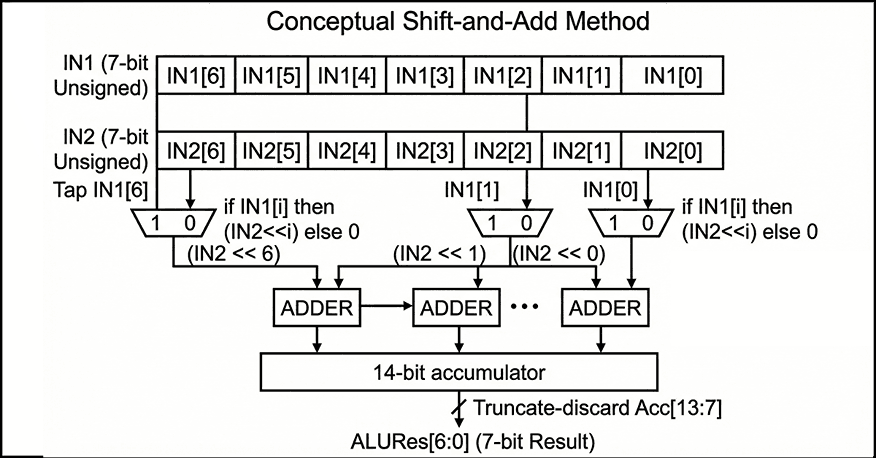
shift add multiply

Figure 2 — Conceptual shift-and-add multiplication accumulates (IN2 << i) for each set bit IN1[i] into a 14-bit sum, then returns only the lower 7 bits as ALURes[6:0].

ROM and “program as VHDL” workflow (Memory.vhd)

The memory is implemented as a 128-entry ROM (instruction(127 downto 0)), addressed by the 7-bit program counter. The output is a direct combinational lookup: Data <= instruction(to_integer(unsigned(address))). The ROM contents are currently defined by assigning specific indices inside the VHDL architecture. This matches your intended workflow: use the Python assembler to generate 7-bit binary instruction words and then paste those encodings into Memory.vhd to run them in simulation.

The file also includes multiple annotated program variants. One example sequence is commented as an “add 7 with 4” demonstration, and another is structured as a small loop intended to exercise conditional branching and repeated arithmetic. A third variant (commented out) is positioned as a “hardware focus” multiplication path, contrasting with the loop-based approach. From an engineering perspective, keeping these snippets inline makes the simulation loop fast, but it also means “program loading” is manual and tightly coupled to the ROM source code rather than being a separate artifact (e.g., a memory initialization file).

Figure placement: A code figure that shows a short ROM snippet (a few consecutive instruction(i) <= "......."; lines) is useful here to make the “assembler output -> ROM initialization” boundary concrete.

Assembler and the hardware–software boundary

To make the processor usable as a co-design exercise rather than a pure hardware artifact, I included a small Python assembler (Assembler/Conversion.py) that translates assembly-like lines into binary strings that can be loaded into the ROM. The intent, as documented in the repository, is to run the conversion step first, then paste the produced encodings into Memory.vhd, and finally validate behavior in simulation by inspecting the program counter, register values, and ALU outputs.

The current assembler implementation is deliberately minimal: it tokenizes each line by removing commas and splitting on whitespace, looks up an opcode mnemonic in a small table, and then encodes operands by type. Register operands (R0–R3) are encoded as 2-bit binary values, while any non-register operand is encoded as a 4-bit binary value. Each instruction line is therefore built by concatenating a fixed-width opcode field with one or more fixed-width operand fields, producing a binary string per line.

This assembler is also where the most important integration contract lives: the binary it emits must match the instruction word format the VHDL control unit expects. The README states the processor operates on 7-bit-wide instructions and provides an example encoding (ADD R1, R2 -> 0100010). In the current Conversion.py, however, the opcode table is 2 bits wide and only covers Load, ADD, SUB, and JNZ, with no explicit MULTIPLY support. In practice, that means the assembler represents the intended direction (software producing ROM-ready bits), but the exact bit-level encoding contract is something the project has to pin down consistently between README, assembler, and the VHDL decode logic. That “tight loop” of adjusting encodings until the fetch/decode/execute behavior matches expectations is part of the educational value of the co-design workflow.

Two targeted questions so I can describe the integration contract precisely in Section 6 (Results) and avoid guessing:

Key implementation notes

  • Source grounding: the narrative is based on README.md and the project snapshot you provided.
  • Entry points: hardware at src/Processor.vhd (top-level integration); software at Assembler/Conversion.py (assembly-to-binary conversion).
  • Core modules: src/ALU.vhd, src/control_unit.vhd, src/Memory.vhd, src/PC.vhd, src/IR.vhd, src/Reg.vhd, src/MUX2x1.vhd, src/MUX4x1.vhd.
  • Top-level integration: src/Processor.vhd instantiates and wires Reg, PC, IR, ALU, MUX4x1 (twice), MUX2x1, Memory, and control_unit, with a single internal bus (RIN <= BUSout) feeding all loadable elements.
  • Control surface: src/control_unit.vhd outputs LD0..LD3, LDIR, LDPC, INC, BUS_Sel, plus CMD, Sel0, and Sel1, and consumes ROUTIR and the per-register zero signals ZR0..ZR3.
  • Halt sentinel: the controller treats 1111111 as a dedicated halt instruction and transitions into a terminal self-loop state.
  • Reg.vhd: rising-edge storage with LD; ZR=1 iff the stored 7-bit value is 0000000.
  • PC.vhd: 7-bit counter with CLR (async clear), LD (load from bus), and INC (increment); supports “load then increment” if both asserted.
  • IR.vhd: rising-edge instruction latch controlled by LD.
  • MUX2x1.vhd: bus-source selector between ROM (I0) and ALU (I1) with a single select bit.
  • MUX4x1.vhd: operand selector over R0–R3 driven by two select bits.
  • ALU.vhd: unsigned add/sub; multiply implemented via shift-and-add; output is truncated to the low 7 bits.
  • Memory.vhd: 128×7 ROM as an internal array with explicit per-address assignments; output is a combinational lookup addressed by PC.
  • Assembler entry point: assemble(assembly_code) consumes a multi-line string and returns a list of binary strings, one per parsed instruction line.
  • Assembler tokenization: commas are stripped (line.replace(",", "")), then tokens are split on whitespace; empty lines are ignored.
  • Assembler encoding: registers (R*) become 2-bit fields; non-register operands become 4-bit fields; the opcode is taken from opcode_table.
  • Assembler opcode coverage: Load, ADD, SUB, JNZ are defined; other instructions (including MULTIPLY) are not represented in the table.
  • Hardware inspection points: Processor exports R0out–R3out explicitly, which makes it practical to validate instruction effects without adding extra debug modules.
  • Software-to-hardware boundary: assemble(...) emits binary strings from assembly-like lines; in the validated workflow these are used to populate the ROM in Memory.vhd.
  • Intended ISA surface: the README presents LOAD/ADD/SUB/JNZ plus an extended MULTIPLY, and frames validation as monitoring ALU output, register values, and program counter progression during simulation.
  • Documentation positioning: the README positions the project explicitly as a simulation-driven, educational processor build with a minimal ISA and a Python conversion step.
  • Encoding contract hotspot: the assembler’s opcode table and assemble(...) are the natural enforcement point for a single instruction-format contract once the bit layout is finalized.

Results

Because I did not build a dedicated VHDL testbench, validation for this project is based on interactive simulation: compiling the full design, loading a short program into the ROM, and then stepping the clock while inspecting the program counter, instruction register, control signals, ALU result, and the four register outputs. This approach matches the project’s educational scope: the primary outcome is a working hardware–software loop where I can translate assembly into binary, paste those encodings into the ROM, and observe the machine executing fetch–decode–execute in a waveform viewer.

Validation checkpoints

In practice, “success” in simulation is visible as a small set of repeatable checkpoints:

  • Fetch discipline: on each instruction boundary, the instruction register captures the ROM output while the program counter advances, yielding a stable next instruction word and a monotonic PC sequence.
  • Load path correctness: a LOAD sequence routes ROM data onto the internal bus and latches it into the selected register, so the register output changes exactly on the intended clock edge.
  • ALU path correctness: ADD and SUB route the ALU result onto the bus and latch it back into a register; the ALU output changes combinationally with operand selection, while architectural state changes only on clock edges.
  • Multiply behavior: the MULTIPLY operation produces a deterministic product consistent with a shift-and-add implementation, with the architectural output constrained to 7 bits (i.e., truncation on overflow) as part of the 7-bit design scope.
  • Conditional control flow observability: conditional branching is validated by correlating (a) the selected register value, (b) its zero flag, and (c) whether the PC is loaded from ROM or advanced past the next word. This makes the branch mechanism debuggable even without a testbench, because the condition and the control effect are both visible.

Artifacts produced

The durable artifacts from a run are simple but useful: (1) binary instruction words produced by the Python assembler and (2) waveform traces in the simulator that show the PC/IR/control/ALU/register timeline for a program. The repository also contains simulator-side artifacts (e.g., waveform databases) under src/, which is consistent with an interactive debug workflow rather than a scripted regression setup.

Discussion

This project’s strongest property is that it forces a clean interface between hardware intent and software representation. The processor design is small enough that I can reason about every signal transition, but complete enough to exercise real co-design constraints: instruction encoding decisions affect decode logic; decode logic constrains what the assembler must emit; and the ROM loading workflow becomes part of the “system contract,” not a separate afterthought.

That said, the absence of a testbench is a real limitation. Interactive waveform inspection is effective for bring-up and learning, but it does not scale to repeatable regression. Without an automated test harness, it is easy to introduce subtle contract drift for example, changes in instruction bit layout, operand field meaning, or zero-flag conventions without immediately noticing. The README asserts that the assembler “supports all implemented instructions,” but the current Conversion.py opcode table only enumerates Load, ADD, SUB, and JNZ, and it encodes operands into fixed 2-bit (register) and 4-bit (immediate) fields, which may or may not match the 7-bit instruction format you ultimately used in ROM. In a co-design project, this kind of mismatch is common and also instructive but it is worth surfacing as a deliberate boundary to tighten.

The architectural constraints are also doing real work here. The 7-bit width means arithmetic overflow is not an edge case; it is a normal mode of operation, and truncation becomes the implicit overflow policy. The ROM-based memory model similarly compresses the problem: by treating “program and data” as a static table, I avoid a full load/store subsystem and can focus on sequencing and datapath correctness. The cost is that the system is simulation-oriented, and “loading a program” is effectively editing VHDL. For the stated educational goal, that trade-off is reasonable, but it is the first thing I would change if I wanted this design to behave more like a reusable platform.

What I would tighten next

If I were evolving this beyond a learning artifact, I would prioritize three reliability-oriented improvements:

  1. Lock the instruction contract: define a single authoritative bit layout (fields, widths, and operand meaning) and make the VHDL decode and the Python assembler share it (even if only by generating a common table/module).
  2. Add a minimal self-checking testbench: one or two short programs with assertions on PC/register end state would turn interactive validation into repeatable regression.
  3. Separate program data from RTL: move ROM initialization into a file-based mechanism supported by the simulator (or at least generate Memory.vhd program blocks automatically from the assembler output) to reduce manual copy/paste drift.

Conclusion

I built this 7-bit processor as a compact hardware–software co-design exercise: a minimal ISA, a VHDL implementation with a clear separation between datapath and control, and a Python assembler that translates human-readable instructions into ROM-ready binary. The design is intentionally constrained 7-bit width, ROM-based memory, and a small instruction set so that the full fetch–decode–execute behavior remains understandable in simulation. Within that scope, the project demonstrates the engineering mechanics that matter in larger systems: defining module contracts, sequencing state updates cleanly, and keeping the software encoding pipeline consistent with hardware decode expectations.

The next step, if I want to make it more robust, is not to add features first; it is to formalize the instruction-format contract and add a minimal self-checking testbench so that the co-design boundary becomes repeatable and verifiable rather than primarily manual.

References

[1] S. Sojudi Abdee Fard, “7-Bit Custom Processor Design for Hardware-Software Co-Design,” GitHub repository (semester 8 / 7-Bit Custom Processor Design). https://github.com/sabers13/bachelor-projects/tree/main/semester%208/7-Bit%20Custom%20Processor%20Design

[2] IEEE Standards Association, “IEEE 1076-2019 IEEE Standard for VHDL Language Reference Manual,” Dec. 23, 2019. https://standards.ieee.org/ieee/1076/5179/

[3] Advanced Micro Devices, Inc., Vivado Design Suite User Guide: Logic Simulation (UG900), v2024.2, Nov. 13, 2024.https://docs.amd.com/r/2024.2-English/ug900-vivado-logic-simulation

[4] Siemens EDA, “ModelSim User’s Manual,” software version 2024.2 (PDF). https://ww1.microchip.com/downloads/aemDocuments/documents/FPGA/swdocs/modelsim/modelsim_user_2024_2.pdf

[5] Python Software Foundation, “Python 3 Documentation,”. https://docs.python.org/

Revolutionizing Construction: 7 Powerful Ways AI and BIM Integration Are Transforming the Industry

Revolutionizing Construction: 7 Powerful Ways AI and BIM Integration Are Transforming the Industry

Estimated Reading Time: 10 minutesThis article presents an in-depth exploration of the integration of Artificial Intelligence (AI) and Building Information Modeling (BIM) as a transformative force in the construction industry. It highlights how machine learning algorithms, IoT systems, and generative design are redefining traditional BIM workflows—shifting from static digital modeling to dynamic, predictive, and self-optimizing systems. Key applications include automated clash detection, predictive maintenance, energy efficiency modeling, and real-time construction monitoring using drones and sensors. The paper addresses technical challenges such as data interoperability and workforce upskilling while showcasing global case studies that demonstrate measurable improvements in cost, safety, and operational efficiency. Ultimately, the article argues that AI and BIM integration marks a new paradigm—essential for achieving intelligent infrastructure and competitive advantage in a data-driven construction future.

The Psychology of Rural Event Planning: Challenges and Opportunities

The Psychology of Rural Event Planning: Challenges and Opportunities

Estimated Reading Time: 12 minutes

Events in rural areas face unique conditions that can significantly influence how they are planned, promoted, and perceived by participants. From agricultural fairs to local festivals and community gatherings, rural events reflect the cultural identity, social networks, and resource constraints of each distinct region. This article explores the psychological dimensions behind organizing, hosting, and attending events in rural contexts, highlighting how tight-knit communities, geographic isolation, and shared traditions shape participant motivation and satisfaction. It also uncovers the hurdles event planners often encounter—such as limited infrastructure, smaller audiences, and logistical complexities—and demonstrates how to address them effectively. Through a discussion of real-world examples and information-based strategies, the article offers insights on creating events that resonate with local values, build communal bonds, and stimulate regional development. In concluding, it examines future perspectives on rural event planning in an era of digital connectivity, stressing the need to balance innovation with respect for local heritage.
By Samareh Ghaem Maghami, Cademix Institute of Technology

Introduction

Rural areas around the globe host a wide range of events—community fairs, agricultural exhibitions, cultural festivals, outdoor concerts, and seasonal markets, among others. These gatherings often serve as a nucleus for social engagement, celebrating local traditions and providing vital economic opportunities. While they can be comparable in concept to urban events, the rural context introduces distinct cultural, economic, and psychological factors that influence planning and outcomes.

Event planners accustomed to metropolitan settings may find themselves facing entirely new challenges in rural areas, such as limited transportation infrastructure, smaller participant pools, and tight-knit social networks. Conversely, rural contexts can also grant unique advantages, including a profound sense of community, deep historical ties, and abundant natural beauty. Recognizing and adapting to these elements allows organizers to develop events that have a genuine impact—fostering social ties, stimulating tourism, and preserving or even reviving local culture.

The psychological dimension is central to understanding rural event planning. People living in smaller or more isolated communities often have strong interpersonal bonds, closely held traditions, and a high regard for communal identity. When events reflect these attributes, they can secure a level of buy-in and loyalty that might be harder to achieve in urban contexts. On the other hand, if event organizers fail to align with local values or attempt to impose an “outsider” vision, they can face skepticism or apathy. This article outlines how psychology informs everything from marketing strategies to venue selection, offering a roadmap for planners seeking to create meaningful and enduring engagements in rural settings.


Unique Characteristics of Rural Settings

Community Ties and Trust

One of the defining traits of rural life is the importance of strong interpersonal relationships. Neighbors often know each other well, and multi-generational families may reside within close proximity. Such connections foster an environment where reputations carry substantial weight, and trust is crucial. For event planners, this means word-of-mouth recommendations and personal endorsements may hold more sway than formal advertising campaigns. When influential community members or local institutions support an event, it can rapidly gain credibility among residents. However, violating community trust—perhaps through mismanagement of resources or broken promises—can have long-lasting repercussions.

Physical and Digital Isolation

While many rural regions experience physical isolation due to limited transport networks, digital connectivity remains inconsistent. Broadband services might be less reliable or slower, influencing how news and promotional materials are disseminated. This partial digital isolation can pose challenges for large-scale online marketing or real-time event updates, especially if the community prefers traditional communication channels like flyers, local newspapers, or radio broadcasts. Yet, with the gradual improvement in digital infrastructure, social media platforms and community forums are playing an increasing role in spreading information and bringing people together.

Economic Realities

Rural economies often rely on agriculture, small businesses, or specialized industries such as forestry, mining, or tourism. Disposable income and sponsorship opportunities may be more limited compared to urban centers. Consequently, events need to justify their value both to participants—who might weigh attendance against other priorities—and to potential sponsors, who may be wary of a smaller audience reach. This economic context can lead to a greater emphasis on cost-sharing, volunteer efforts, or community-driven fundraising to keep event ticket prices accessible.

Closeness to Nature

The natural environment is a prized resource in many rural areas. Rolling farmland, forests, or mountainous backdrops can be integral to the event experience, offering scenic value or unique outdoor activities. With this comes an added layer of logistics—weather patterns, wildlife considerations, or environmental regulations may shape the feasibility and timing of events. Yet, the rural setting’s natural beauty can be a powerful draw, particularly for city dwellers seeking a reprieve from urban life. Strategically incorporating natural elements into the program design can enhance the emotional impact and create a memorable experience.

Cultural and Historical Depth

Some rural communities have preserved traditions and lifestyles that trace back decades or even centuries. These historical threads help form the backbone of communal identity. Events can tap into this cultural richness by featuring local crafts, storytelling, folk music, or cuisine. Aligning a festival’s theme with cherished traditions fosters a sense of pride and belonging. At the same time, it is essential to remain sensitive to evolving norms and outside influences—balancing the desire for authenticity with an openness to innovation.


Psychological Factors Influencing Participation

Sense of Belonging and Community Pride

In rural areas, the event experience often goes beyond entertainment; it reaffirms communal bonds. Attending a local festival or fair means supporting friends, neighbors, or local organizations. This sense of belonging can be a powerful motivator, encouraging even those who might have limited disposable income or face logistical barriers to show up. The flip side is that if an event does not resonate with community identity—or worse, appears to undermine local values—residents may reject it outright. Planners need to demonstrate authenticity by involving community stakeholders early on and incorporating local voices in everything from programming to venue decor.

Social Validation and Word-of-Mouth Dynamics

Rural social circles can be tightly interwoven, meaning the perceived success or popularity of an event can hinge on the endorsements of influential individuals. Testimonials, personal invites, and casual conversations over morning coffee can all serve as potent promotional tools. In some cases, the “bandwagon effect” is heightened because people do not want to feel excluded from a shared community experience. By ensuring positive early interactions—perhaps through a pilot event or a small gathering with respected local figures—planners can generate a wave of enthusiasm that reverberates through word-of-mouth channels.

Accessibility and Comfort Zones

Potential attendees might have concerns about accessibility—whether due to physical distance, limited public transportation, or a personal reluctance to venture outside familiar settings. Psychological comfort can be a significant factor, especially if an event aims to introduce innovative ideas or attract external visitors. Some locals may fear that large crowds or unfamiliar entertainment could dilute their community’s identity. Conversely, outsiders might hesitate to travel to a region they perceive as remote or insular. Addressing these concerns openly—through clear directions, group travel options, or reassuring messaging—can reduce anxiety and encourage broader participation.

Nostalgia and Emotional Resonance

Rural events often tap into nostalgia: memories of childhood, family traditions, or simpler times. This emotional resonance can be a key driver of attendance. For example, a harvest festival might remind older residents of past celebrations tied to the farming cycle, while younger generations get a glimpse of their cultural heritage. Planners can leverage this nostalgia by incorporating traditional music, vintage exhibits, or intergenerational activities, all of which anchor the event in collective memory. Yet, it is important to strike a balance with current trends, ensuring the event also appeals to modern tastes and interests.

Perceptions of Safety and Familiarity

Many rural communities place high value on personal safety, closeness, and stability. Large-scale events or those that introduce unfamiliar components—such as exotic food vendors or non-local musical acts—can trigger apprehension. Showcasing safety measures, collaborating with local authorities, and offering “preview” snippets or demos can help ease concerns. Equally significant is the sense of emotional safety. Attendees should feel free to express themselves, explore new ideas, or connect with outside visitors without fear of judgment. When events provide an environment where curiosity and hospitality intersect, they reinforce participants’ psychological comfort and willingness to engage.


Strategies for Effective Event Planning

Inclusive Stakeholder Involvement

Engaging local stakeholders from the outset is crucial. This may include community leaders, business owners, farmers, and residents who can offer valuable perspectives on local norms and logistical constraints. Forming a planning committee that reflects the community’s diversity—age groups, cultural backgrounds, professional sectors—ensures that multiple viewpoints are considered. Including youth representatives, for instance, can bring fresh ideas to a heritage-based festival, helping balance tradition with innovation. Early consultation fosters transparency, mitigating rumors or misunderstandings that can undermine trust.

Contextual Marketing and Promotion

Events in rural areas often rely on personalized, relationship-based promotion. Instead of generic mass advertising, planners might leverage local radio stations, bulletin boards in community centers, or flyers posted in grocery stores and cafes. Social media can still play a role, particularly among younger demographics, but messages should be aligned with local sensibilities. Storytelling approaches—like a short video featuring residents explaining why the event matters—often resonate deeply. Highlighting shared values, communal benefits, and traditions can strengthen emotional connections, whereas overly slick or corporate-style campaigns might raise skepticism.

Leveraging Local Assets

Rural communities can provide planners with unique venues and cultural resources. Barns, town squares, historical churches, or natural landscapes can serve as compelling backdrops for events. Local artisans, bakers, or musicians can contribute authentic touches that align with community pride. Even practical items, like farm equipment or horses, can be incorporated if they fit thematically. These local elements anchor the event experience in something distinctly tied to the region. Building on what is already available—and acknowledging the expertise of local people—also reduces expenses and fosters buy-in.

Cross-Generational Programming

Because rural communities often encompass multiple generations living side by side, event activities should cater to a broad demographic spectrum. Seniors might appreciate lectures or exhibits focusing on local history, while younger attendees gravitate toward interactive games, sports tournaments, or live music. Workshops that bring different age groups together—like a craft session where elders teach traditional skills—can encourage intergenerational bonding. By blending traditional forms of entertainment with contemporary offerings, the event stands a better chance of appealing to families and individuals with diverse interests.

Partnerships and Collaboration

Rural event planners may need to collaborate with local NGOs, governmental agencies, or regional tourism boards to secure funding and logistical support. Many governments and non-profit entities provide grants to initiatives that promote culture, community health, or economic development in rural areas. Partnerships can also extend beyond the local region, particularly if the aim is to attract visitors from nearby cities or other states. Joint marketing campaigns that highlight scenic drives, regional attractions, or culinary tours can entice urban dwellers looking for a different experience. Coordinating with local businesses ensures that attendees have access to amenities like lodging, dining, and transportation, thereby enhancing overall satisfaction.

Sustainability and Environmental Responsibility

Given the close relationship between rural communities and their natural surroundings, demonstrating environmental stewardship can significantly enhance an event’s reputation. Simple measures—like offering recycling stations, using biodegradable packaging, or partnering with local farmers for food supplies—can signal respect for the land and align with eco-conscious values. Some rural areas might also be sensitive ecosystems, so careful planning to minimize ecological impact fosters goodwill with both residents and environmental advocates. Moreover, visitors seeking “green” or low-impact travel may be drawn to events that showcase sustainable best practices.

Contingency Planning

Rural environments are sometimes more vulnerable to weather extremes, road closures, or power outages. Preparing contingency plans—like shifting an outdoor event to a covered barn or arranging generator backups—can save time, money, and community goodwill. Publicizing a clear communication protocol (e.g., local radio updates, text alerts) ensures attendees know what to expect in the event of a sudden change. By proactively addressing these variables, planners can reduce uncertainty and keep participant trust intact.


Measuring Impact and Future Perspectives

Assessing Attendee Satisfaction

Effectively measuring the success of a rural event extends beyond ticket sales or foot traffic. Planners should consider qualitative feedback—such as interviews, focus groups, or surveys—that capture participants’ emotional responses, sense of community pride, and willingness to attend similar events in the future. Online feedback forms can work when community members have reliable internet, but paper surveys or comment boxes at local gatherings may yield higher response rates in regions with limited connectivity. A genuine effort to incorporate this feedback into future planning cycles illustrates accountability and fosters a culture of continuous improvement.

Tracking Economic and Social Benefits

For many rural areas, events serve as catalysts for economic development, injecting revenue into local businesses and providing part-time employment opportunities. Beyond direct income from ticket sales or vendor fees, local shops, accommodation providers, and restaurants benefit when visitors come to town. Additionally, strong events can promote investment in infrastructure (such as improved roads or broadband) that yields lasting benefits. Socially, events might spark new friendships or community initiatives, strengthening local networks. Tracking these broader outcomes requires coordination with local authorities, business associations, and community organizations, but the data can be invaluable in shaping long-term development plans and justifying future funding.

Fostering Community Resilience

In rural settings, a successful event can transcend the immediate occasion, becoming a cornerstone of community identity and resilience. Regular festivals and gatherings cultivate a sense of continuity, helping preserve local traditions through periods of economic or social change. They can also serve as platforms for addressing communal challenges—from mental health awareness to agricultural innovation—by incorporating educational workshops or speaker sessions. Over time, these recurring events can build a reputation that extends beyond local borders, attracting tourism and forging partnerships with regional or even international organizations.

Embracing Digital Innovations

Even in areas with modest internet connectivity, digital tools can augment rural events by offering new forms of engagement. Livestreamed concerts or talks may capture the attention of distant audiences, while online ticketing systems can streamline management and data collection. Hybrid models, featuring on-site festivities combined with digital components for remote participants, can make the event accessible to friends and family who have moved away. Nevertheless, the psychological comfort of local attendees should remain a priority. A careful balance is needed so that digital innovations enhance rather than overshadow the communal atmosphere that is central to rural events.

Evolving Cultural Narratives

Rural communities are not static; they evolve as younger generations introduce new perspectives, and economic or environmental conditions change. Likewise, rural events must adapt to remain relevant. A harvest festival might pivot to highlight sustainable farming practices in response to climate concerns, or a traditional crafts fair could include modern art sections to appeal to youth. The ongoing challenge is to maintain authenticity while embracing growth. Successful planners engage locals in shaping the event’s future direction, ensuring the community feels a sense of ownership and sees the event as reflecting their collective identity rather than an imposed vision.


Conclusion

Event planning in rural areas requires a nuanced understanding of local culture, psychological motivators, and logistical constraints. These communities often prize authenticity, heritage, and interpersonal connections, making the success of an event contingent on its alignment with local values and its ability to foster genuine emotional resonance. Planners who delve into the social and psychological dimensions—by involving community members, leveraging word-of-mouth influence, and offering inclusive and meaningful programming—are better positioned to create experiences that are both memorable and impactful.

At their best, rural events serve as living expressions of a community’s identity and aspirations. They can generate economic opportunity, preserve cultural practices, and strengthen social bonds that define life in less urbanized regions. While challenges like limited infrastructure, isolation, and resource constraints are real, they can also be catalysts for creative solutions that enhance an event’s authenticity and sense of place. In a world that increasingly values connection and authenticity, rural areas have a golden opportunity to showcase their unique charm.

Looking ahead, rural event planners can harness improving digital tools to broaden reach while carefully preserving the intimate, communal essence that sets these gatherings apart. By grounding decisions in ethical principles, cultural respect, and a deep appreciation for local psychology, they can design events that not only succeed in the present but also lay the foundation for a thriving, adaptive future for rural communities. Ultimately, it is this blend of tradition and innovation—rooted in authentic human connection—that empowers rural events to leave a lasting imprint on both the people who call these places home and the visitors who come to learn, celebrate, and connect.

Selecting Contractors and Comparing Renovation Quotations Without Comparing Apples to Oranges

Estimated Reading Time: 20 minutesThe renovation of existing structures presents a unique set of challenges that distinguish it fundamentally from new-build construction. In greenfield projects, the baseline is often defined by clear geometric boundaries, standardized material specifications, and predictable site conditions. The ground is known; the sky is open.…

Using 3D CAD and Digital Twins Before Starting a Home Renovation

Estimated Reading Time: 15 minutesThe landscape of residential renovation is undergoing a fundamental transformation, shifting from an era defined by intuitive guesswork and reactive adjustments to one characterized by precision, predictability, and digital foresight. For property owners, investors, and technical professionals, the traditional reliance on two-dimensional floor plans and…

How CRM Enhances the Trust Quadrant of Content Matrix in 2025 Mohsen Hashemipour Hashemi Pour

How CRM Enhances the Trust Quadrant of Content Matrix

Estimated Reading Time: 14 minutes

In an increasingly competitive digital landscape, developing and maintaining trust with potential customers has become a strategic imperative. By leveraging the power of a robust CRM (Customer Relationship Management) system in tandem with the “trust quadrant” of the content matrix, businesses can systematically deliver information-based, personalized messages that guide prospects along the customer journey. This approach positions relevant data—such as case studies, comparative analyses, and real-world results—exactly where it is needed, ensuring that audiences remain in the high-trust zone until conversion. Moreover, CRM-driven segmentation and automation enable real-time responsiveness and precise follow-ups, creating a strong foundation for sustained brand loyalty and long-term growth.
By Seyed Mohsen Hashemi Pour, Cademix Institute of Technology

Introduction

Content marketing often revolves around a strategy known as the content matrix, which divides content into different “quadrants” or categories, each serving a specific purpose in the customer journey. One of the most critical of these quadrants is the trust quadrant—or the third quadrant—where you provide factual, data-driven, and logically presented material to build confidence in your brand.

While crafting solid, trust-focused content is crucial, many businesses overlook an essential operational element: a Customer Relationship Management (CRM) system. CRM may not be content itself, but it is the tool that ensures potential customers remain in the trust zone long enough to convert into loyal buyers. In this article, we explore how CRM supports and amplifies the effectiveness of trust-building content, offering an actionable blueprint for businesses looking to elevate their content marketing strategy.


Understanding the Content Matrix and the Trust Quadrant


Understanding the fundamental structure of content marketing strategies requires a close look at the content matrix, a conceptual framework that categorizes various forms of content according to their purpose and impact on the audience. Within this matrix, marketers typically identify four distinct quadrants: entertainment, inspiration, education, and trust. Each quadrant has a unique role in shaping how consumers perceive a brand, engage with its messaging, and ultimately make purchasing decisions. The quadrant dedicated to trust has recently gained increased attention in the marketing community because it addresses a specific stage in the customer journey where potential buyers seek facts, logical proof, and external validation before they commit. By exploring why people rely on demonstrable information and credible sources to feel secure in their choices, businesses can adjust their strategies to present exactly the kind of information these individuals need in order to move forward. The core idea of the content matrix is to ensure that you produce, distribute, and manage different types of content in a balanced manner, without relying on a single style or message to reach all potential customers. While entertaining or inspirational content may succeed in drawing initial attention and sparking interest, and educational content might provide knowledge or skill-building opportunities, the trust quadrant plays the critical role of removing lingering doubt. When users reach a certain point in their decision-making process, they typically need to confirm that the brand or product is genuinely capable of meeting their expectations. The trust quadrant exists to satisfy that need by offering objective, expert-oriented materials such as case studies, data-backed comparisons, testimonials from respected voices in the field, or transparent demonstrations that showcase product performance. In essence, the content matrix acknowledges that different psychological drivers come into play at different stages of the customer journey, and that trust-building is not a trivial component but rather a decisive element that encourages customers to take the final leap. This paragraph sets the stage for a detailed exploration of why the trust quadrant matters, how it interacts with other quadrants, and why it is so crucial to modern marketing strategies that aim to convert uncertain browsers into confident buyers.


The content matrix organizes marketing materials into four categories based on the audience’s mindset and the goals of the brand. Entertainment content, for instance, grabs attention by tapping into humor, novelty, or emotional appeal; it captivates people who are scrolling through social media or browsing websites, but it rarely goes deep enough to persuade them to consider a purchase or further investigate a brand’s credibility. Inspiration content focuses more on motivational stories, uplifting narratives, and aspirational imagery, often evoking strong emotions that can prompt individuals to see a product or service as aligned with a better version of themselves or a greater cause. Educational content aims to inform, instruct, and deliver insights that empower readers, viewers, or listeners. By offering how-to guides, tutorials, research findings, and white papers, a brand demonstrates its expertise in a particular field and fosters a sense of appreciation or even indebtedness from the audience. Yet, while educational content can be effective in opening people’s minds to new possibilities or clarifying complicated topics, it does not necessarily close the gap on skepticism. The trust quadrant, meanwhile, centers on the necessity of presenting data, information, and verifiable sources that confirm a brand or product can do what it promises. This might involve real-world examples such as usage statistics, documented improvement metrics, or third-party accolades like awards and certifications that reinforce the brand’s position as a serious, reputable player. Each quadrant in the content matrix interlocks with the others, forming a cohesive system of messaging that addresses different psychological stages. When a consumer first learns of a brand, they may be drawn by entertaining or inspirational elements. As they continue to explore, they appreciate the chance to learn something new about the field or problem area they are dealing with. Ultimately, when they begin seriously evaluating their options, they need the kind of proof that sits squarely in the trust quadrant to feel ready to commit. The interrelationship between these quadrants allows marketers to map out a content journey that meets audiences exactly where they are, whether that is looking for a spark of interest, a sense of direction, concrete knowledge, or final assurance that they are making a sound choice. Hence, the trust quadrant is critical because it establishes the definitive credibility that persuades the final purchase decision, ideally building a loyal relationship rather than a one-time sale.


The trust quadrant is the realm of content that aims to transform curiosity and general interest into confidence and reassurance. It delves beyond simple brand messages or promotional slogans, presenting tangible, data-supported, and often externally validated materials that give potential customers a clear sense of security. Examples include case studies where a company’s solutions have measurably improved metrics like efficiency or cost savings for a client, detailed comparison charts that honestly juxtapose different solutions in the same category, and real testimonials or endorsements that show how independent parties, such as established industry figures or satisfied clients, have put their weight behind the product. This quadrant is grounded in the principle that many buyers want to see objective or semi-objective information that goes beyond just marketing hype or flashy ads. By focusing on facts and logical arguments, it touches on a more analytical side of consumer behavior. Some individuals may be swayed by emotional appeal in the early stages of awareness or interest, but as soon as they realize they might actually spend money or invest time in a product, they shift to a mindset that demands more certainty. The trust quadrant therefore serves a unique function in the broader ecosystem of the content matrix. It also distinguishes itself from educational content, which can sometimes be informative yet still somewhat abstract. Educational materials might explain a theory, a method, or an industry trend, but trust-oriented materials take that further by demonstrating concrete application and results that your product or service can deliver. In essence, it is about backing up claims with visible proof, whether that proof is manifested as an infographic, a chart derived from real usage data, or even quotes from experts who are known to have stringent standards. The goal is not simply to show that your brand is knowledgeable, but also that it has a track record of real-world accomplishment and authenticity. As the digital marketplace grows more crowded, the significance of this quadrant increases, since consumers are bombarded with countless offers and claims. Being able to distinguish your offerings through verifiable facts can cut through that noise. The trust quadrant is therefore the decisive zone in which skepticism is mitigated and a sense of clarity takes hold. Without solid content in this area, many potential leads may linger in indecision or look elsewhere for more transparent vendors.


One of the most direct reasons the trust quadrant is crucial is that it operates as a conversion catalyst. People often begin their buying journey by becoming casually aware of a brand or problem, possibly engaging with entertaining or inspirational content that piques their curiosity. However, curiosity alone usually is not enough to lead to a concrete purchase, especially if the item or service in question represents a major investment of money, effort, or personal data. At a certain stage, individuals want to see unambiguous proof that an offering is genuinely capable of solving their specific pain point, delivering the features they desire, or outperforming alternatives. This is where the trust quadrant enters the picture. It provides the rational, data-backed perspective that people require to justify their decisions. If the early quadrants of content draw people into the funnel, the trust quadrant is what nudges them to take definitive action and convert. This phenomenon is partly driven by the inherent risk that consumers perceive when they face purchasing decisions. Even modest purchases can bring about moments of hesitation, while higher-stakes transactions raise even more serious doubts. By placing fact-based information in front of your audience—like product demonstrations, success metrics, or thoughtful comparisons with competing solutions—you empower them to feel certain that they are making a sound choice. That certainty does not just help in the moment; it can also lead to higher satisfaction down the road, since consumers feel they were fully informed rather than swayed by glossy branding alone. The trust quadrant’s status as a conversion catalyst is especially visible in segments where competition is intense and brand loyalty is not yet established. When prospective buyers have many similar options, they often look for the one that seems most credible, verifiable, and aligned with their goals. If you effectively show them genuine results, past client experiences, or expert endorsements that highlight your brand’s reliability, you differentiate yourself from competitors who might rely only on vague promises. This rational layer of reassurance can accelerate the buyer’s journey, taking them from the realm of speculation to the realm of decisive action. Without trust-building content, you may draw plenty of interest but struggle to close deals, leaving potential leads to wander or second-guess whether your solution truly fits their needs.


The trust quadrant is also a powerful driver of authority and credibility for brands that want to stand out in their niche. While entertainment, inspiration, and educational content can demonstrate creativity, empathy, and subject matter expertise, the trust quadrant cements the brand’s position as a serious, reliable source. It typically features assets like industry certifications, third-party endorsements, or proven success stories that show the brand did not simply craft a compelling narrative, but has also been recognized and validated in the real world. Showing certifications from relevant authorities, or awards from recognized industry bodies, indicates that you have met externally verified standards. Similarly, when you highlight customer testimonials that discuss actual improvements in metrics such as lead generation, operational costs, or user satisfaction, you allow your audience to see real transformations. These testimonials come across as less biased than purely promotional material, because they reflect experiences of peers or industry insiders who have faced similar challenges. When trust-building content is integrated well, it also underscores the brand’s leadership, positioning it as a thought leader or pioneer who is pushing boundaries in a given sector. In highly technical or regulated industries, the trust quadrant can be indispensable. Audiences in fields such as healthcare, engineering, finance, or research often demand proof that goes beyond surface-level marketing. They want to see data sets, compliance with regulations, or endorsements from established figures within the community. Without that level of detail, a brand may struggle to break into serious consideration, no matter how polished the other aspects of its content might be. Even in consumer-facing sectors like retail or entertainment, showcasing that a product has been rigorously tested or endorsed by a well-known figure or respected publication can help to remove doubts. When you consistently and transparently share verifiable proof of your capabilities, you earn a reputation that can outlast short-lived trends. People may remember your brand as the one that offered them clear information, addressed their concerns openly, and allowed them to make an informed decision. This creates a more robust connection to your audience, built on a sense of respect and reciprocity. Once you establish authority and credibility in this way, you also open the door to long-term relationships that extend beyond a single purchase, as satisfied customers often become vocal advocates who reinforce your brand’s trustworthiness among their peers or professional networks.


The final aspect that underscores the significance of the trust quadrant is its role in reducing perceived risk and giving potential buyers the final reassurance they need to close the deal. Whether a person is shopping for a new software platform, a personal development course, or a cutting-edge piece of hardware, the step of committing financial or personal resources frequently triggers a phase of heightened skepticism. Consumers may ask themselves if they have overlooked any hidden drawbacks, if the price truly reflects the value, or if the brand’s claims might be exaggerated. When such doubts remain unresolved, prospects can stall, abandon their cart, or postpone their decision indefinitely. The trust quadrant addresses this hesitation by putting forth information that is not only compelling but also verifiable. For instance, if you include a thorough side-by-side comparison that explains how your offering differs from existing solutions in terms of cost-effectiveness, efficiency, or durability, you effectively preempt the question of whether you are hiding any shortcomings. If you highlight concrete data—perhaps from a pilot program, an A/B test, or real-world usage figures—then anyone reading your content can see the validity of your claims without having to take you at your word. This transparency reassures them that they are not walking into a trap but instead are making a logical choice based on ample information. Another ingredient in the trust quadrant is typically some form of success story or client testimonial that mirrors the prospect’s own context or challenges. When a person sees that another individual or organization with similar issues achieved measurable benefits, they can project those benefits onto their own situation with greater confidence. It alleviates the fear of wasting resources on a product that might not live up to expectations. As a result, prospects find it easier to decide that the risk is manageable or even minimal, given the level of assurance provided. Ultimately, the trust quadrant is not about manipulating or deceiving people but rather about offering them all the facts they need to make a choice they can stand behind. This fosters a healthier, more transparent relationship between the brand and the consumer, one that often leads to greater satisfaction, fewer returns or disputes, and a higher likelihood of positive word-of-mouth. By carefully understanding and applying the principles of trust-building content, marketers can both expand their market share and enhance the overall reputation of their company. In today’s competitive environment, harnessing the power of the trust quadrant is no longer optional for brands that want to thrive; it is a strategic necessity that ensures your promise to customers is backed by tangible, factual support every step of the way.

CRM as the Operational Backbone

A CRM system allows you to collect, track, and analyze customer interactions—ranging from the first website visit to post-purchase follow-up. While the trust quadrant focuses on what content to create (case studies, statistics, product comparisons, etc.), CRM is about using data to deliver this content effectively and maintain the audience’s trust throughout their journey.

2.1. Streamlining the Customer Journey

  • Data Collection: A CRM platform logs interactions such as email opens, product page visits, and webinar attendances. These data points show you which trust-building materials are working.
  • Audience Segmentation: CRM tools let you group prospects by needs, behaviors, or demographics. This segmentation means you can send the most relevant white papers, testimonials, or factual insights to the right audience segments.

2.2. Holding Customers in the ‘Trust Zone’

  • Real-Time Responsiveness: CRM data on customer inquiries and concerns enables fast, fact-based replies.
  • Personalized Follow-Up: When a lead shows interest in a specific product feature, your CRM-triggered workflow can send them in-depth tutorials or expert reviews, keeping them engaged and informed.

Practical Integration: CRM + Trust Quadrant Content

Below are actionable ways to integrate CRM insights into your trust-building content strategy:

3.1. Data-Driven Content Creation

Analyze common customer queries, product usage patterns, and frequently visited webpages in your CRM. Use this information to develop:

  • Detailed FAQs addressing the top concerns.
  • Expert Webinars focused on recurring pain points.
  • Case Studies that highlight measurable results for specific customer segments.

3.2. Tailored Content Delivery

Once the CRM identifies a user’s buying stage or product interest, you can:

  • Automate Email Sequences: Send a comparison table or industry report right after someone downloads a relevant brochure.
  • Time-Sensitive Promotions: If the CRM shows a user repeatedly visiting a pricing page, you might share a limited-time offer that aligns with their interest.

3.3. Feedback Loop and Continuous Improvement

By tracking how often people open, click, or respond to your trust-oriented content, you can refine what you produce:

  • Adjust Formats: Maybe videos perform better than lengthy PDFs.
  • Tweak Messaging: If certain product claims resonate more than others, double down on those in new materials.

Illustrative Success Examples

Even a brief, hypothetical case study can show how combining CRM insights with trust-building materials boosts results:

  1. Before CRM
    • Situation: A small software firm relied solely on one-size-fits-all blog posts about its product. Trust-building content (case studies, proven metrics) existed but was scattered.
    • Problem: Customer pain points were unclear, engagement was low, and the sales funnel had frequent drop-offs.
  2. After CRM Implementation
    • Approach: The firm used a CRM to tag leads by their industry (e.g., healthcare, manufacturing) and track which product features each lead viewed.
    • Outcome: They delivered specialized comparisons, ROI statistics, and relevant success stories to each segment. Conversion rates improved because leads found precise information that addressed their concerns.

Conclusion

The trust quadrant in your content matrix is where leads transform into long-term customers—provided they receive logical, data-backed, and transparent information. A CRM solution ensures that the right trust-building materials reach the right audience at the right time, continuously reinforcing confidence.

By aligning CRM insights (segmentation, tracking, personalization) with the creation and distribution of trust-focused content, businesses can hold prospects in the “trust zone” and successfully guide them toward a purchase. This synergy between well-structured content and CRM-driven engagement is what ultimately fosters loyalty and advocacy, creating a repeatable, scalable foundation for customer trust and business growth.

How CRM Enhances the Trust Quadrant of Content Matrix in 2025 Mohsen Hashemipour Hashemi Pour

Ready to optimize your own trust quadrant? Start by reviewing your CRM data for gaps in your content strategy. Identify where potential customers hesitate or lose confidence, then deliver tailored, fact-based content that addresses their concerns head-on. By systematically applying CRM insights to your trust-building content, you can ensure each customer feels guided and confident from first contact to final purchase—and beyond.