Estimated Reading Time: 10 minutesExplore how to become a numerical analyst, from uncertainty quantification and simulation to technical projects and career portfolios.
Cademix Institute of Technology, Austria | +43 650 967 7080 | info@cademix.org

Technology, Career Acceleration, Continuing Education & European Business Services
Estimated Reading Time: 10 minutesExplore how to become a numerical analyst, from uncertainty quantification and simulation to technical projects and career portfolios.
Estimated Reading Time: 11 minutesPlan a Monte Carlo analysis for engineering uncertainty, including input distributions, model validation, sensitivity and confidence intervals.

Estimated Reading Time: 10 minutesExplore the data scientist career pathway in causal inference, including statistics, observational data methods, portfolio projects and professional skills.


In today’s construction industry, manufacturing, distribution, design, and project execution are often managed by separate companies. While this traditional structure allows businesses to specialize in their own fields, I experienced a different approach—one that demonstrated how Technical Sales can connect these disciplines to create greater value for manufacturers, partners, and customers alike.
Rather than operating as a conventional reseller, I established my own independent company and developed a partner-led business model with a thermowood supplier, Lunawood. Instead of competing within the same sales channel, we built a collaborative relationship where each company focused on its core strengths.

The supplier concentrated on manufacturing and supplying premium thermowood products, while my company became responsible for converting customer inquiries into fully executed projects through technical consultation, design, commercial negotiation, and project management.
Whenever potential customers contacted the supplier and required design, engineering, or installation services, they were referred directly to my company. From that point onward, I managed the entire sales process. As a Technical Sales professional, my responsibility extended far beyond presenting products. I met with clients, analyzed their technical and commercial requirements, provided consultation, developed design concepts, prepared technical proposals, negotiated contracts, and coordinated project execution. Once an agreement was reached, I purchased the required thermowood materials from the supplier and managed the successful delivery of the project.
This model allowed every participant to focus on what they did best. The supplier no longer needed to invest additional resources in customer consultations, project design, or sales engineering. Instead, they concentrated on manufacturing high-quality products and maintaining consistent supply. Meanwhile, my company delivered complete project solutions instead of simply selling materials. Clients benefited from working with a single point of contact who understood both the technical requirements and the commercial objectives of their projects. Looking back, I believe the success of this model was built on three fundamental principles.
Specialization – Each organization focused on its area of expertise while avoiding unnecessary operational complexity. Trust – Customer referrals required mutual confidence and a long-term commitment between both companies. Value Creation – Rather than competing for the same revenue stream, we generated additional value through collaboration, resulting in higher customer satisfaction and increased business opportunities for both organizations.
More importantly, this experience transformed my understanding of Technical Sales.
Many people associate sales with persuading customers to purchase a product. However, in project-based industries such as construction, successful Technical Sales is fundamentally different. It requires understanding customer needs, translating technical requirements into practical solutions, coordinating multiple stakeholders, managing commercial negotiations, and reducing project risk.
Throughout these projects, I realized that I was not simply acting as a salesperson. I was simultaneously a technical consultant, designer, business developer, project manager, and solution provider. My role was to bridge the gap between engineering expertise and commercial success while ensuring that every stakeholder achieved their objectives.
This experience led me to define what I now call a Partner-Led Technical Sales Model—a collaborative framework where manufacturers, technical sales professionals, designers, and contractors work together to deliver integrated solutions instead of individual products.
I believe this model can be successfully applied across construction, architecture, engineering, industrial manufacturing, and other project-based industries where customers require expertise rather than product recommendations alone.
As markets become increasingly competitive, organizations that build collaborative ecosystems instead of isolated sales channels will develop stronger customer relationships, improve conversion rates, and achieve more sustainable long-term growth.
For me, this experience demonstrated that the future of B2B sales is not simply about selling products—it is about Technical Sales professionals creating value by combining technical expertise, business development, and strategic partnerships to deliver complete customer solutions.
Ultimately, the most successful companies will not be those with the largest product portfolios, but those that build the strongest networks of expertise. In that environment, Technical Sales becomes far more than a sales function—it becomes the strategic bridge between innovation, partnership, and customer success.

The construction industry is undergoing a significant transformation. Customers are no longer looking for suppliers who simply provide materials at competitive prices. They increasingly expect partners who can understand complex requirements, provide technical guidance, reduce uncertainty, and contribute to successful project outcomes. This shift has increased the importance of Technical Sales as a strategic function that connects products, expertise, and business objectives.
In traditional sales models, the primary focus is often placed on product availability, pricing, and transaction volume. However, construction projects involve many variables that cannot be addressed through product sales alone. Every project has unique technical requirements, architectural considerations, budget limitations, regulatory conditions, and execution challenges. Therefore, Technical Sales professionals play a critical role by transforming customer problems into engineered solutions.
A successful Technical Sales approach begins with understanding the customer’s real needs. In many cases, customers may initially request a specific product, but the underlying challenge is usually broader. They may need assistance with material selection, performance expectations, installation methods, durability requirements, design integration, or cost optimization. A Technical Sales professional identifies these hidden requirements and provides guidance that creates long-term value.
This approach changes the relationship between supplier and customer. Instead of being viewed as a simple purchasing interaction, the relationship becomes a collaborative process where both parties work toward achieving a successful project result. This creates stronger trust and increases the likelihood of long-term cooperation.
One of the most valuable aspects of Technical Sales is its ability to connect technical knowledge with commercial understanding. Engineers often focus on performance, specifications, and technical accuracy, while business teams focus on profitability, market opportunities, and customer relationships. Technical Sales professionals operate between these two areas.
They understand technical details but can also communicate them in a way that supports business decisions. They can explain why a certain solution is suitable, how it creates value, and why it may represent a better long-term investment despite differences in initial cost. In construction projects, this ability is particularly important because decisions made during the early stages can significantly influence the final outcome. A material choice, design modification, or installation recommendation can affect project quality, maintenance requirements, and customer satisfaction for many years.
Through Technical Sales, organizations can move from being product providers to solution partners. This creates differentiation in competitive markets where many companies offer similar products. The competitive advantage no longer comes only from what a company sells, but from how effectively it helps customers achieve their goals.
The construction market is becoming increasingly knowledge-driven. Customers have access to more information than ever before, but access to information does not always create understanding. Technical Sales professionals provide the expertise required to evaluate information and make confident decisions.
For example, a customer selecting a building material may compare different suppliers based only on price. However, a Technical Sales approach considers additional factors such as product lifespan, environmental impact, installation complexity, maintenance requirements, and overall project value. This perspective allows customers to understand the complete lifecycle value of a solution rather than focusing only on the initial purchase cost. As a result, Technical Sales contributes to better decision-making and improved project performance.
In my experience, customers often appreciate working with professionals who can simplify complex decisions. When a company provides technical support, design assistance, and project guidance, customers feel more confident because they know they are not purchasing a product alone—they are investing in expertise and reduced risk.
Modern industries are becoming increasingly interconnected. No single company can always provide every required capability internally. Successful organizations therefore build ecosystems where different specialists contribute their unique strengths. The Partner-Led Technical Sales Model represents this evolution. Instead of companies competing individually, they create networks based on cooperation and shared value creation. Manufacturers provide product expertise and production capabilities. Technical Sales professionals provide market knowledge, customer communication, and solution development. Designers contribute creativity and technical vision, while contractors ensure practical execution.
When these capabilities are connected effectively, customers receive a complete solution rather than separate services from disconnected suppliers. This ecosystem approach also creates benefits for manufacturers. By working with skilled Technical Sales partners, manufacturers can expand their market presence without significantly increasing internal sales and technical resources. They can focus on improving their products while relying on specialized partners to develop opportunities and support customers. For Technical Sales professionals, partnerships create opportunities to become more than sales representatives. They become strategic contributors who influence market development, customer relationships, and business growth.
Redefining Success in Technical Sales
Success in Technical Sales should not be measured only by the number of products sold. A more meaningful measurement is the value created throughout the entire customer journey.
A successful Technical Sales professional helps customers define problems, evaluate solutions, manage risks, and achieve successful results. The final outcome is not simply a completed transaction but a satisfied customer, a strengthened partnership, and future business opportunities.
This requires a combination of skills that extend beyond traditional sales abilities.
Technical knowledge, communication skills, negotiation capability, project management experience, and business development understanding are all essential components of modern Technical Sales. The most effective professionals in this field continuously develop themselves. They learn about new materials, technologies, market trends, sustainability requirements, and customer expectations. They understand that expertise is not a fixed achievement but an ongoing process.
Sustainability is becoming one of the most important factors influencing construction decisions. Customers, architects, and developers increasingly consider environmental impact, material responsibility, and long-term performance when selecting solutions. Technical Sales professionals have an important role in supporting sustainable decision-making. By understanding product characteristics and project requirements, they can recommend solutions that balance technical performance, economic value, and environmental responsibility.
For example, materials with improved durability and lower environmental impact require proper explanation and technical justification. Customers need to understand not only the immediate benefits but also the long-term advantages of sustainable choices. This creates another opportunity for Technical Sales professionals to provide value. They become educators and advisors who help customers navigate increasingly complex decisions.
Looking back at my experience, I recognize that Technical Sales represents much more than a commercial activity.
It is a discipline built on understanding, collaboration, and problem-solving. The greatest achievement was not simply delivering projects or generating revenue.
The real achievement was creating a system where different organizations could work together more effectively and where customers received solutions that exceeded their initial expectations. This experience changed my perspective on sales. I no longer see sales as convincing someone to buy a product.
I see it as the process of discovering challenges, creating solutions, and building relationships based on trust and expertise. The future belongs to professionals and organizations that can combine technical knowledge with strategic thinking. As industries become more complex, customers will increasingly depend on experts who can guide them through difficult decisions.
Technical Sales will continue to grow as a critical function because it represents the connection between innovation and practical application.
It transforms technical capabilities into customer value and converts partnerships into sustainable business growth. Ultimately, the strongest organizations will not succeed only because of the products they manufacture or distribute.
They will succeed because they understand customer challenges, collaborate effectively, and create complete solutions through expertise-driven relationships. This is the true power of Technical Sales: creating value beyond the product itself.
References and Further Reading
To learn more about sustainable thermowood solutions, visit the official Lunawood website:
https://lunawood.com
For additional insights into customer value creation, B2B sales strategy, and modern business development practices, readers may also refer to Harvard Business Review:
https://hbr.org
Further research on construction industry trends and business transformation can be found through McKinsey & Company:
https://www.mckinsey.com/industries/engineering-construction-and-building-materials
These resources provide valuable perspectives on Technical Sales, strategic partnerships, customer-centric business models, and innovation within project-based industries.

Estimated Reading Time: 10 minutesA practical causal inference analysis plan covering confounders, propensity scores, AIPW, validation, assumptions and responsible business use.
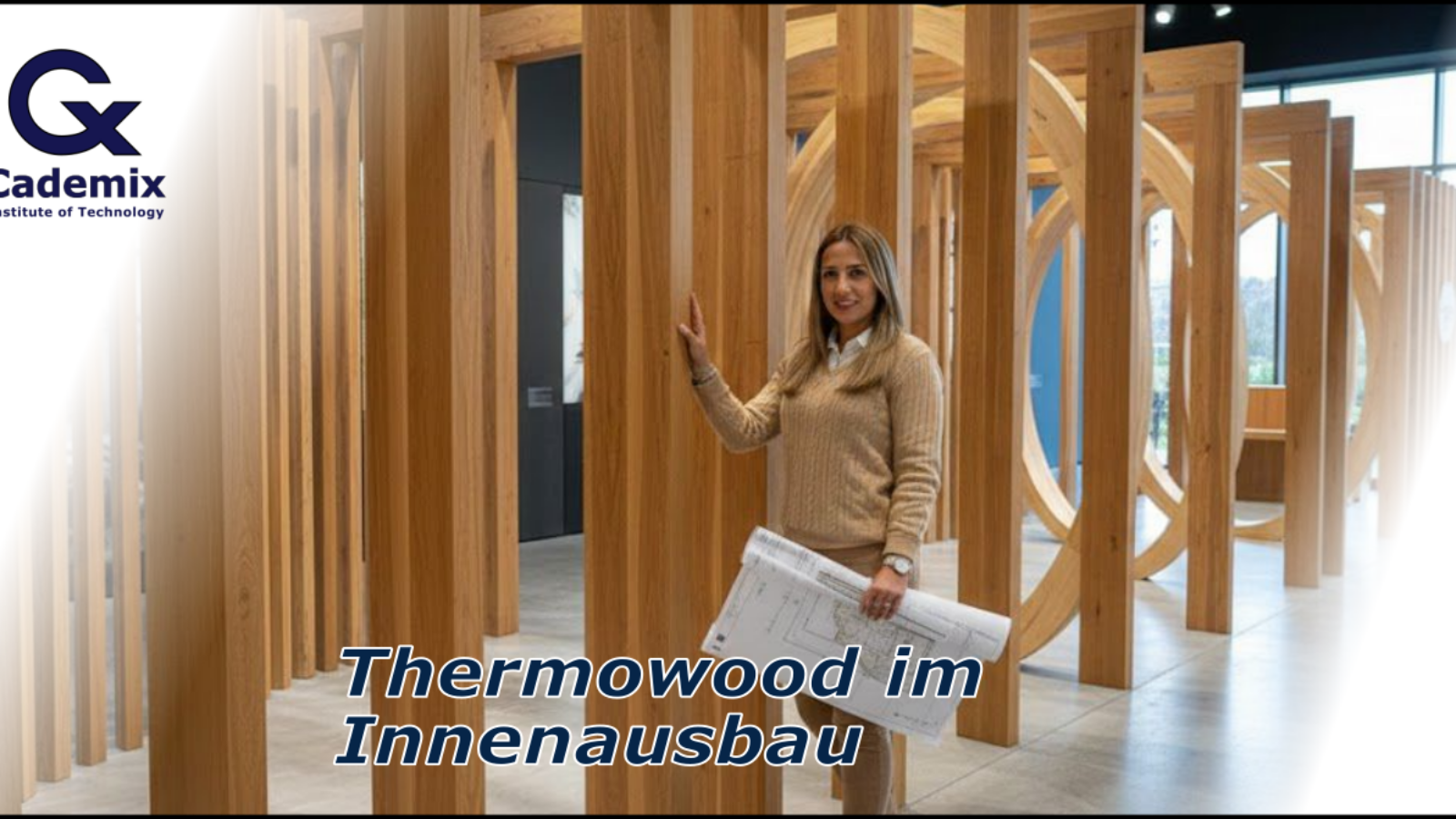
Der Thermowood Innenausbau ist ein zentraler Trend im modernen Innenausbau, der Ästhetik, Funktionalität und Nachhaltigkeit vereint. Für Auftraggeber, Architekt:innen und Bauherren sind langlebige, ökologische und optisch ansprechende Materialien entscheidend. Thermowood erfüllt diese Anforderungen optimal und eröffnet vielseitige Möglichkeiten für hochwertige Innenräume.
In diesem umfassenden Fachartikel erläutere ich die Vorteile, Einsatzbereiche, praktische Erfahrungen sowie Planungs- und Ausführungsstrategien für Thermowood Innenausbau. Ziel ist es, Auftraggebern fundierte Einblicke zu geben und meine Expertise in diesem Bereich sichtbar zu machen.Nazanin Farkhondeh, Cademix Institute of Technology, Austria
Thermowood ist Holz, das durch thermische Behandlung bei Temperaturen von 160 bis 220 °C modifiziert wird. Der Prozess erfolgt ausschließlich mit Hitze und Wasserdampf, ohne chemische Zusätze. Dies stabilisiert die Zellstruktur des Holzes, reduziert die Feuchtigkeitsaufnahme und erhöht die Dauerhaftigkeit erheblich – Eigenschaften, die im Innenausbau von entscheidender Bedeutung sind.
Die thermische Modifikation führt zu einer dunkleren, gleichmäßigen Farbgebung, die Holzarten wie Esche, Kiefer oder Buche besonders attraktiv macht. Im Thermowood Innenausbau wird dieses Material sowohl für sichtbare Elemente als auch für funktionale Bauteile wie Einbaumöbel, Wand- und Deckenverkleidungen verwendet.
Thermowood zeichnet sich zudem durch Resistenz gegen Schimmel, Pilze und Insekten aus. Dies macht es zu einer besonders langlebigen und pflegeleichten Lösung für Innenräume, sowohl im privaten als auch im gewerblichen Bereich.
Die Kombination aus natürlicher Ästhetik und hoher Haltbarkeit macht Thermowood zu einem idealen Material für Projekte, bei denen Design, Funktionalität und Nachhaltigkeit gleichermaßen gefragt sind.
Die reduzierte Feuchtigkeitsaufnahme verhindert Verziehen und Schrumpfen. Thermowood behält seine Form über Jahre hinweg, was besonders für maßgefertigte Möbel und Wandverkleidungen wichtig ist. Auftraggeber profitieren dadurch von langlebigen, wartungsarmen Innenausbauten.
Darüber hinaus bietet Thermowood durch seine natürliche Stabilität eine hohe Tragfähigkeit, sodass auch komplexe Konstruktionen problemlos realisiert werden können. Dies ist besonders für großflächige Wand- oder Deckenverkleidungen relevant.
Thermowood überzeugt durch eine edle Farbgebung und ruhige Holzstruktur. Im Innenraum entsteht eine warme, einladende Atmosphäre. Im hochwertigen Thermowood Innenausbau wird das Holz oft bewusst sichtbar eingesetzt, um Designelemente zu betonen und dem Raum Charakter zu verleihen.
Da bei der Herstellung keine chemischen Zusätze verwendet werden, ist Thermowood vollständig recyclebar und ökologisch unbedenklich. Für Auftraggeber, die auf nachhaltige Bauweise achten, bietet Thermowood eine langfristig wertbeständige Lösung.
Thermisch behandeltes Holz reguliert die Feuchtigkeit im Raum und unterstützt so ein ausgeglichenes Raumklima. Im Thermowood Innenausbau sorgt dies für angenehm temperierte und gesunde Räume, sowohl im Wohn- als auch im Objektbereich.
Thermowood kann in nahezu allen Bereichen des Innenausbaus eingesetzt werden: Deckenpaneele, Wandverkleidungen, Einbaumöbel, Treppen, Regale und akustische Elemente. Die Kombination aus Ästhetik, Stabilität und Nachhaltigkeit macht es besonders flexibel.

Nachhaltige Innenarchitektur erfordert Materialien, die langlebig und ökologisch vertretbar sind. Thermowood erfüllt diese Kriterien und passt hervorragend zu modernen Architekturstilen. In Kombination mit Glas, Stahl oder Stein entstehen kontrastreiche Designs, die sowohl Eleganz als auch Natürlichkeit vermitteln.
Auftraggeber profitieren von Wertbeständigkeit, Investitionssicherheit und einem sichtbaren Bekenntnis zu nachhaltigem Bauen. Thermowood unterstützt zudem Zertifizierungen nach Standards wie DGNB oder LEED.
Die Möglichkeit, Thermowood in Kombination mit anderen nachhaltigen Materialien einzusetzen, eröffnet Architekt:innen und Designern kreative Freiheit und erlaubt individuelle Raumkonzepte für unterschiedlichste Projekte.
Die fachgerechte Montage ist entscheidend für den Erfolg eines Projekts. In meiner täglichen Praxis vermittle ich Handwerkern und Monteuren die Besonderheiten des Materials, um die optimale Umsetzung zu gewährleisten.
[Platzhalter Bild 2: Erklärung von Thermowood für Arbeiter auf der Baustelle]
Präzision und Know-how sichern ein langlebiges, ästhetisch hochwertiges Ergebnis. Auch die richtige Lagerung während des Transports und die sorgfältige Auswahl der Befestigungsmaterialien sind entscheidend für eine fehlerfreie Montage.
Eine erfolgreiche Umsetzung beginnt mit detaillierter Planung. Materialstärken, Lichtführung, Übergänge zu anderen Bauteilen und Befestigungen müssen frühzeitig definiert werden. 3D-Modelle und Materialmuster helfen, Auftraggebern die Wirkung des späteren Raumes zu visualisieren.
Die enge Abstimmung zwischen Planern, Handwerkern und Auftraggebern ist entscheidend. Auch logistische Aspekte wie Transport, Lagerung und Montage sollten frühzeitig berücksichtigt werden, um Schäden am Material zu vermeiden.
Durch sorgfältige Projektplanung lassen sich Kosten reduzieren, Zeitpläne einhalten und ein qualitativ hochwertiges Ergebnis erzielen.
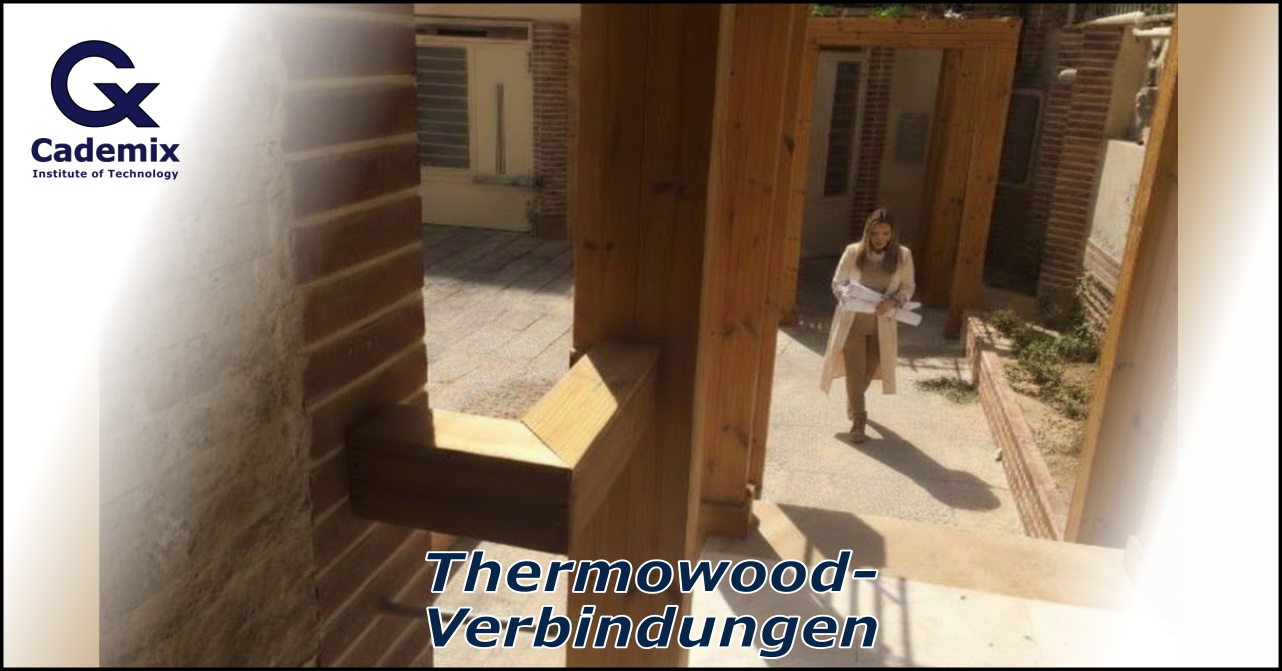
In einem exklusiven Wohnprojekt wurden Thermowood-Paneele als Wandverkleidung eingesetzt. Ziel war es, ein warmes, einladendes Ambiente zu schaffen und gleichzeitig langlebige Oberflächen zu garantieren. Durch die thermische Behandlung konnte das Holz resistent gegen Feuchtigkeit und Temperaturunterschiede gemacht werden, was besonders in Bereichen wie Küche und Bad von Vorteil ist.
Die Zusammenarbeit mit Architekt:innen und Handwerkerteams ermöglichte eine passgenaue Umsetzung der Designideen. Jeder Wandabschnitt wurde präzise zugeschnitten und montiert, sodass nahtlose Übergänge und ein hochwertiges Erscheinungsbild erreicht wurden.
[Platzhalter Bild 3: Maßgefertigte Wandverkleidung im Wohnbereich]
In einem modernen Bürogebäude wurde Thermowood für Deckenpaneele und Akustikelemente eingesetzt. Der Einsatz von Thermowood trug zur Reduzierung von Lärm und zur Verbesserung der Raumakustik bei. Gleichzeitig verlieh es den Räumen eine warme, natürliche Optik, die ein angenehmes Arbeitsumfeld unterstützt.
Die Montage erfolgte in enger Abstimmung mit Licht- und Klimakonzepten, um ein harmonisches Zusammenspiel von Material, Lichtführung und Funktionalität zu gewährleisten.
[Platzhalter Bild 4: Thermowood Deckenpaneele im Büro]
In einem Wellnesshotel wurden Thermowood-Möbel und Wandverkleidungen kombiniert, um eine harmonische und natürliche Umgebung zu schaffen. Thermowood wurde aufgrund seiner Feuchtigkeitsbeständigkeit besonders in Sauna- und Nassbereichen eingesetzt. Die Kombination aus Ästhetik und Funktionalität überzeugte sowohl die Betreiber als auch die Gäste.
Ein zentraler Bestandteil meiner Arbeit ist die Wissensweitergabe. Ich organisiere Seminare und Workshops für Planer, Handwerker und Auftraggeber, um das Verständnis für Thermowood zu vertiefen und die fachgerechte Anwendung sicherzustellen.
Die Schulungen umfassen:
Durch diese Seminare profitieren Auftraggeber direkt, da geschulte Teams Projekte effizienter und qualitativ hochwertiger umsetzen. Zudem fördern die Workshops Innovation und den Austausch von Best Practices innerhalb der Branche.
Der Einsatz von Thermowood im Innenausbau wird in Zukunft weiter zunehmen, insbesondere in nachhaltigen Bauprojekten. Neue Oberflächenbehandlungen, digitale Planungsmethoden und innovative Verbindungstechniken erweitern die Einsatzmöglichkeiten und steigern die Effizienz.
Farblich variierende Thermowood-Oberflächen eröffnen Designern neue Spielräume. Durch digitale Lasertechniken können individuelle Muster, Logos oder Texturen direkt in die Holzoberfläche eingearbeitet werden.
Die Integration von Thermowood in digitale Planungsprozesse und BIM-Modelle (Building Information Modeling) ermöglicht präzise Kalkulationen und eine frühzeitige Abstimmung aller Gewerke. Dies reduziert Fehler und optimiert die Projektkosten.
Mit der zunehmenden Bedeutung nachhaltiger Architektur werden Materialien wie Thermowood, die ökologisch unbedenklich und langlebig sind, immer wichtiger. Thermowood unterstützt Zertifizierungen nach Standards wie DGNB, LEED oder BREEAM und trägt zur ökologischen Bewertung von Gebäuden bei.
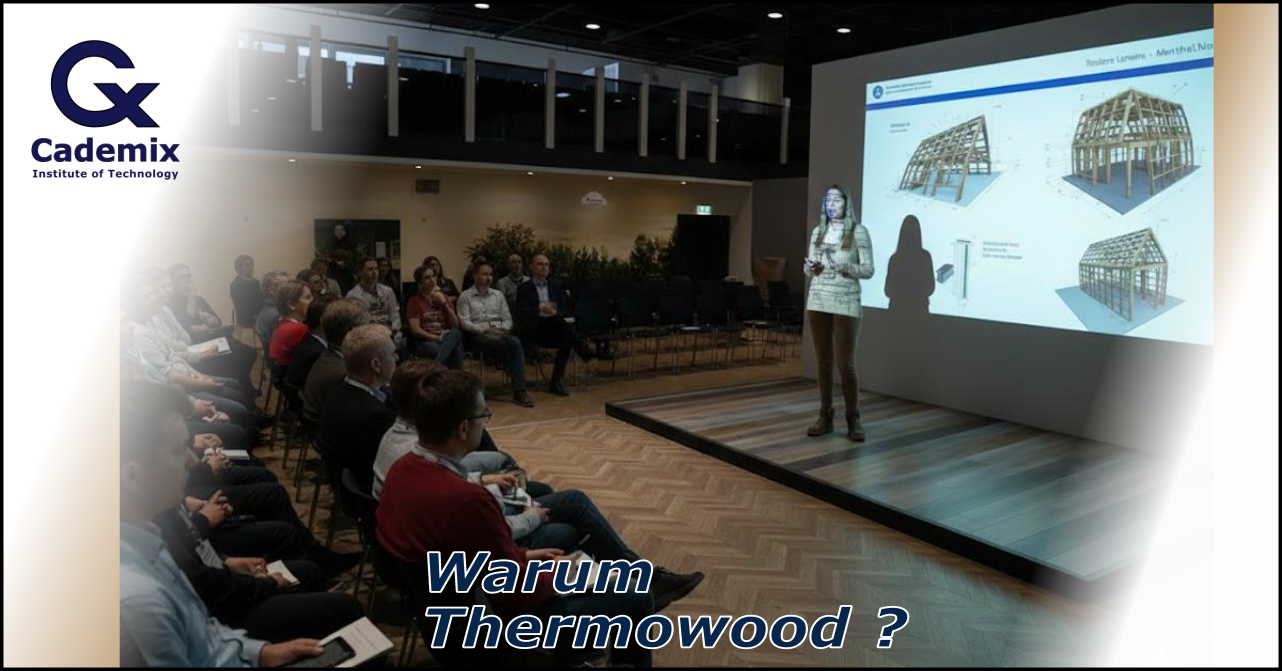
Der Thermowood Innenausbau vereint Design, Technik und Nachhaltigkeit auf einzigartige Weise. Mit sorgfältiger Planung, fachgerechter Umsetzung und fundiertem Wissen lassen sich Innenräume schaffen, die sowohl ästhetisch als auch funktional überzeugen. Auftraggeber profitieren von langlebigen, wartungsarmen und nachhaltigen Lösungen, die den Wert der Immobilie erhöhen.
Thermowood bietet eine Vielzahl von Vorteilen:
Durch die Integration von Thermowood in Projekte zeigen Auftraggeber und Architekt:innen ein klares Bekenntnis zu Qualität und Nachhaltigkeit. Die Kombination aus praktischer Erfahrung, Fachwissen und kreativen Lösungen macht Thermowood zu einer zukunftssicheren Wahl für moderne Innenausbauprojekte.
Dieser Artikel ist speziell auf die Bedürfnisse von Auftraggebern zugeschnitten und optimiert für den Fokus-Keyword Thermowood Innenausbau, um Expertise, Praxiserfahrung und professionelle Umsetzung sichtbar zu machen.

Dieser Artikel dokumentiert die Renovierung eines älteren Bestandsgebäudes aus der Perspektive der Planung, Umsetzung und fachlichen Entscheidungsfindung. Im Mittelpunkt steht Renovierung nicht als isolierte Baumaßnahme, sondern als ganzheitlicher Prozess, der den respektvollen Umgang mit bestehender Bausubstanz, die Verbesserung von Sicherheit und Energieeffizienz sowie die Anpassung an zeitgemäße Nutzungsanforderungen miteinander verbindet. Anhand eines realisierten Projekts wird gezeigt, wie architektonische Identität bewahrt, technische Systeme erneuert und räumliche Qualitäten weiterentwickelt werden können, ohne den historischen Charakter des Gebäudes zu verlieren. Der Beitrag versteht sich als praxisnaher Erfahrungsbericht und verdeutlicht, dass qualitätsvolle Renovierung einen nachhaltigen Beitrag zur langfristigen Nutzung und zum Erhalt urbaner Strukturen leisten kann.
Nazanin Farkhondeh, Cademix Institute of Technology, Austria
Renovierung ist kein rein technischer Vorgang. In meiner beruflichen Praxis habe ich Renovierung immer als eine Haltung verstanden – als bewusste Entscheidung, mit bestehender Bausubstanz verantwortungsvoll umzugehen, statt sie durch standardisierte Neubauprozesse zu ersetzen. Gerade bei älteren Gebäuden geht es nicht nur um Substanz, sondern um Erinnerung, Identität und städtebauliche Kontinuität.
Dieses Projekt steht exemplarisch für diese Haltung. Es handelt sich um die umfassende Renovierung eines älteren Gebäudes, das zwar funktional und technisch stark überholt war, dessen architektonischer Charakter jedoch nach wie vor eine klare Qualität besaß. Die Aufgabe bestand nicht darin, etwas völlig Neues zu schaffen, sondern das Vorhandene weiterzudenken.
Der folgende Artikel dokumentiert diesen Prozess aus der Perspektive der Planung, der technischen Umsetzung und der inhaltlichen Entscheidungen. Er versteht sich nicht als theoretische Abhandlung, sondern als praxisnaher Erfahrungsbericht aus einem realisierten Renovierungsprojekt.
Das Gebäude befand sich in einem gewachsenen urbanen Umfeld und war Teil eines etablierten Stadtgefüges. Seine Entstehung liegt mehrere Jahrzehnte zurück, was sich sowohl in der Bauweise als auch in der Grundrissstruktur deutlich zeigte. Zum Zeitpunkt der Renovierung entsprach es weder aktuellen technischen Standards noch zeitgemäßen Nutzungsanforderungen.
Gleichzeitig verfügte das Gebäude über Eigenschaften, die im heutigen Bauen selten geworden sind. Die Proportionen waren ausgewogen, die Fassadengliederung ruhig und präzise, und die verwendeten Materialien vermittelten eine handwerkliche Qualität, die über reine Zweckmäßigkeit hinausging.
Gerade diese Merkmale führten früh zu der Entscheidung, auf einen Abriss zu verzichten. Eine Renovierung erschien nicht nur wirtschaftlich sinnvoll, sondern auch architektonisch und städtebaulich verantwortungsvoll. Das Gebäude hatte eine Geschichte – und diese sollte nicht ausgelöscht, sondern weitergeführt werden.

Die Definition klarer Ziele war ein entscheidender Schritt zu Beginn des Projekts. Ohne eine präzise Zielsetzung besteht bei Renovierungen die Gefahr, sich in Einzelmaßnahmen zu verlieren oder widersprüchliche Entscheidungen zu treffen.
Im Zentrum stand der Anspruch, die architektonische Identität des Gebäudes zu bewahren und gleichzeitig seine Nutzbarkeit grundlegend zu verbessern. Die Renovierung sollte nicht museal wirken, sondern ein Gebäude hervorbringen, das heutigen Anforderungen gerecht wird, ohne seine Herkunft zu verleugnen.
Ein weiterer Schwerpunkt lag auf der strukturellen Sicherheit und der technischen Erneuerung. Das Gebäude musste den aktuellen Normen entsprechen, ohne dass diese Anpassungen sichtbar dominierend werden. Renovierung bedeutete hier, technische Notwendigkeit und gestalterische Zurückhaltung in Einklang zu bringen.
Eine sorgfältige Bestandsanalyse ist bei jeder Renovierung unverzichtbar. In diesem Projekt bildete sie die Grundlage aller weiteren Schritte. Es ging nicht nur darum, Schäden zu identifizieren, sondern das Gebäude als System zu verstehen.
Die Tragstruktur wurde detailliert untersucht, ebenso die vorhandenen Materialien und deren Zustand. Dabei zeigte sich, dass viele Bauteile trotz ihres Alters noch über eine solide Substanz verfügten, während andere Bereiche gezielte Eingriffe erforderten.
Parallel dazu wurden die bestehenden Installationen analysiert. Heizung, Elektrik und Leitungsführung entsprachen nicht mehr den heutigen Anforderungen und mussten vollständig neu gedacht werden. Diese Erkenntnisse flossen direkt in das Planungskonzept ein und verhinderten spätere improvisierte Lösungen.
Der Entwurfsprozess war geprägt von der Frage, wie viel Veränderung notwendig und wie viel Zurückhaltung sinnvoll ist. Renovierung bedeutet immer auch, Entscheidungen über Eingriffe zu treffen – und bewusst auf andere zu verzichten.
Die äußere Erscheinung des Gebäudes blieb weitgehend erhalten. Veränderungen an der Fassade wurden auf ein Minimum reduziert und beschränkten sich auf technische Optimierungen und notwendige Instandsetzungen. Neue Elemente wurden so gestaltet, dass sie klar als zeitgenössische Ergänzungen erkennbar sind, ohne sich in den Vordergrund zu drängen.
Im Inneren hingegen war mehr Spielraum für Anpassungen vorhanden. Hier konnte die Renovierung genutzt werden, um räumliche Qualitäten neu zu definieren, ohne die Grundstruktur des Gebäudes zu zerstören. Dieser bewusste Unterschied zwischen äußerer Zurückhaltung und innerer Weiterentwicklung prägte den gesamten Entwurfsansatz.
Ein zentraler Bestandteil der Renovierung war die statische Ertüchtigung des Gebäudes. Altersbedingte Schwächen, frühere Umbauten und veränderte Nutzungsanforderungen machten gezielte Maßnahmen erforderlich.
Diese Eingriffe wurden mit großer Sorgfalt geplant. Ziel war es, die Tragfähigkeit und Sicherheit deutlich zu erhöhen, ohne die architektonische Erscheinung zu verändern. Verstärkungen erfolgten dort, wo sie konstruktiv sinnvoll waren, und blieben nach Möglichkeit unsichtbar.
Die Renovierung zeigt hier exemplarisch, dass Sicherheit und Ästhetik keine Gegensätze sein müssen. Durch präzise Planung lassen sich selbst umfangreiche statische Maßnahmen so integrieren, dass sie das Gesamtbild nicht beeinträchtigen.
Die vollständige Erneuerung der technischen Infrastruktur war einer der aufwendigsten Teile der Renovierung. Alte Systeme wurden entfernt und durch zeitgemäße Lösungen ersetzt, die sowohl effizient als auch langlebig sind.
Besonderes Augenmerk lag auf der Energieeffizienz. Durch verbesserte Dämmung, optimierte Heizsysteme und eine durchdachte Haustechnik konnte der Energieverbrauch deutlich reduziert werden. Diese Maßnahmen sind nach außen kaum sichtbar, tragen jedoch maßgeblich zur langfristigen Qualität des Gebäudes bei.
Gerade bei Renovierungen zeigt sich, dass technische Qualität oft im Verborgenen liegt. Ein gut renoviertes Gebäude erkennt man nicht an auffälligen Installationen, sondern an seiner ruhigen, selbstverständlichen Funktionalität.
Ein weiterer Schwerpunkt der Renovierung lag auf der Verbesserung der inneren Raumstruktur. Die ursprünglichen Grundrisse waren stark fragmentiert und entsprachen nicht mehr den heutigen Anforderungen an Flexibilität und Offenheit.
Durch gezielte Eingriffe konnten Räume geöffnet, Sichtbeziehungen verbessert und natürliche Belichtung verstärkt werden. Gleichzeitig wurde darauf geachtet, die ursprüngliche Logik des Gebäudes nicht zu zerstören. Die Renovierung verstand sich hier als Weiterentwicklung, nicht als radikaler Umbau.
Besonders wertvoll war die Reaktivierung zuvor wenig genutzter Bereiche. Flächen, die früher kaum Aufenthaltsqualität boten, wurden in funktionale und gut belichtete Räume transformiert. Dadurch gewann das Gebäude nicht nur an Fläche, sondern vor allem an Nutzungsqualität.
Die Auswahl der Materialien spielte eine entscheidende Rolle für den Charakter der Renovierung. Neue Materialien sollten den Bestand ergänzen, nicht imitieren. Gleichzeitig mussten sie langlebig und wartungsarm sein.
In vielen Bereichen wurde bewusst mit einfachen, robusten Materialien gearbeitet, deren Qualität sich erst im Gebrauch zeigt. Details wurden reduziert ausgeführt, um den Fokus auf Raumwirkung und Proportionen zu legen.
Diese Zurückhaltung ist typisch für hochwertige Renovierungsprojekte im mitteleuropäischen Raum, insbesondere in Österreich, wo Klarheit und Ehrlichkeit im Umgang mit Materialien als Qualitätsmerkmal gelten.
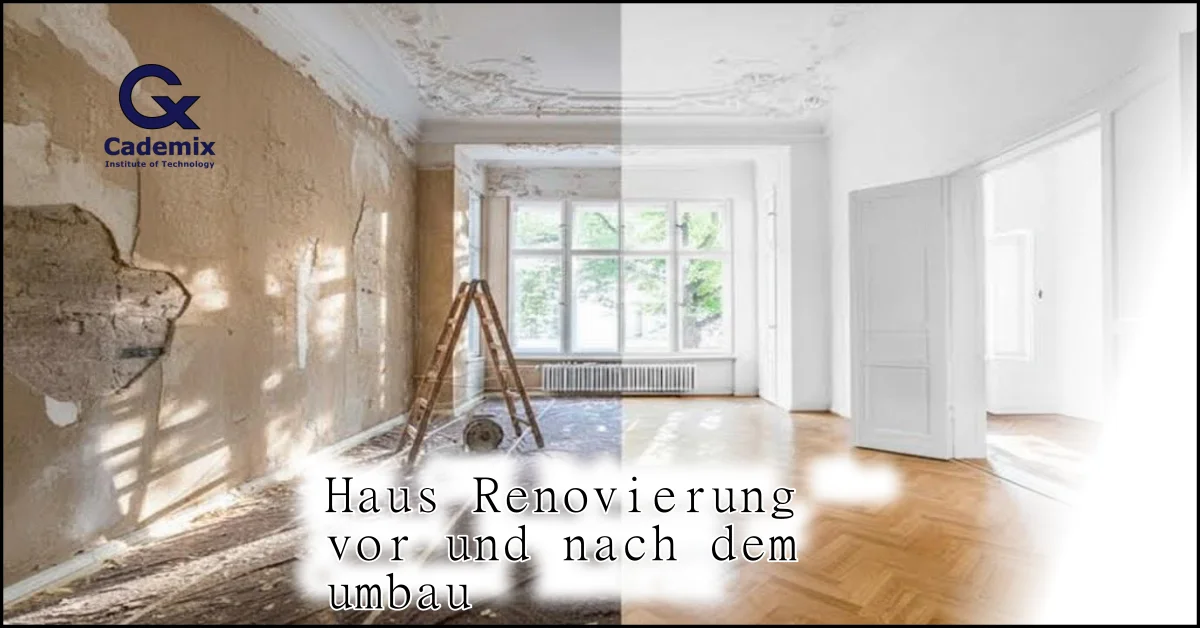
Kein Renovierungsprojekt verläuft ohne Herausforderungen. Auch hier traten im Laufe der Umsetzung unerwartete Situationen auf, die flexible Anpassungen erforderten.
Besonders anspruchsvoll war die Koordination zwischen bestehenden Bauteilen und neuen Eingriffen. Jede Entscheidung musste sorgfältig abgewogen werden, da Fehler im Bestand oft schwerer zu korrigieren sind als im Neubau.
Durch eine klare Projektstruktur, enge Abstimmung aller Beteiligten und realistische Zeitplanung konnten diese Herausforderungen jedoch bewältigt werden, ohne die Qualität des Ergebnisses zu gefährden.
Ein konkretes Beispiel für die im Artikel beschriebene Herangehensweise an Renovierung ist ein Projekt, das wir in Teheran realisiert haben. Das Gebäude befand sich in einem innerstädtischen Quartier mit überwiegend älterer Bausubstanz und wies deutliche Spuren jahrzehntelanger Nutzung auf. Ziel der Renovierung war es nicht, das Gebäude grundlegend zu verändern, sondern seinen baulichen Zustand präzise zu analysieren, Schwachstellen zu identifizieren und auf dieser Basis eine nachhaltige Erneuerung umzusetzen.
Ein wesentlicher Bestandteil dieses Projekts war die detaillierte Bestandsaufnahme vor Ort. Die vorhandene Bausubstanz wurde systematisch geprüft, unter anderem hinsichtlich Materialzustand, Oberflächen, Feuchtigkeitseintrag und thermischem Verhalten der Außenwände. Diese Untersuchungen bildeten die Grundlage für alle weiteren Entscheidungen und ermöglichten es, Eingriffe gezielt und verhältnismäßig zu planen, anstatt pauschale Maßnahmen anzuwenden.
Im Rahmen der Renovierung lag ein besonderer Fokus auf der Gebäudehülle. Die Außenflächen zeigten altersbedingte Abnutzungen, die sowohl ästhetische als auch funktionale Auswirkungen hatten. Durch eine Kombination aus Instandsetzung, materialgerechter Behandlung und gezielten Verbesserungen konnte die Substanz gesichert und gleichzeitig die Lebensdauer des Gebäudes deutlich verlängert werden. Dabei wurde bewusst darauf geachtet, den Charakter des Bestands zu erhalten und keine gestalterischen Brüche zu erzeugen.
Auch dieses Projekt verdeutlicht, dass Renovierung unabhängig vom geografischen Kontext nach denselben professionellen Prinzipien erfolgen sollte: sorgfältige Analyse, Respekt vor dem Bestand und klare Zieldefinition. Die Erfahrungen aus Teheran zeigen, dass eine strukturierte und verantwortungsvolle Renovierung nicht nur die technische Qualität eines Gebäudes verbessert, sondern auch einen langfristigen Beitrag zur Werterhaltung und Nutzbarkeit leistet.
Ein zunehmend wichtiger Aspekt zeitgenössischer Architektur ist die Frage der Nachhaltigkeit. In diesem Zusammenhang gewinnt die Renovierung bestehender Gebäude eine strategische Bedeutung, die weit über rein wirtschaftliche Überlegungen hinausgeht. Jedes Bestandsgebäude repräsentiert bereits gebundene Energie, Ressourcen und kulturellen Wert. Eine sorgfältig geplante Renovierung ermöglicht es, diese vorhandenen Potenziale weiter zu nutzen, anstatt sie durch Abriss und Neubau zu vernichten.
Im vorliegenden Projekt wurde Nachhaltigkeit nicht als isoliertes technisches Ziel verstanden, sondern als integraler Bestandteil des gesamten Planungsprozesses. Bereits in der frühen Konzeptphase wurde geprüft, welche Bauteile erhalten, repariert oder angepasst werden können. Diese Herangehensweise führte nicht nur zu einer Reduktion von Bauabfällen, sondern auch zu einer bewussteren Auseinandersetzung mit dem Wert des Bestands.
Ein weiterer zentraler Aspekt der nachhaltigen Renovierung ist die Lebenszyklusperspektive. Entscheidungen über Materialien, Konstruktionen und technische Systeme wurden nicht allein auf Basis der Investitionskosten getroffen, sondern im Hinblick auf Wartungsaufwand, Langlebigkeit und Anpassungsfähigkeit. Gerade bei Renovierungen zeigt sich, dass kurzfristige Einsparungen häufig langfristig höhere Kosten verursachen können.
Darüber hinaus spielt die soziale Nachhaltigkeit eine wichtige Rolle. Eine Renovierung verändert nicht nur ein Gebäude, sondern beeinflusst auch seine Nutzer und sein Umfeld. Durch die Verbesserung von Raumqualität, Tageslichtführung und funktionaler Klarheit konnte das Gebäude wieder zu einem attraktiven und identitätsstiftenden Ort werden. Dies stärkt nicht nur die Nutzung, sondern auch die emotionale Bindung der Nutzer an den Ort.
Im internationalen Kontext wird Renovierung zunehmend als Schlüsselstrategie für eine verantwortungsvolle Stadtentwicklung verstanden. Während Neubau häufig mit hohem Ressourcenverbrauch verbunden ist, bietet die Arbeit im Bestand die Möglichkeit, bestehende Strukturen intelligent weiterzuentwickeln. Das hier beschriebene Projekt reiht sich in diese Haltung ein und zeigt exemplarisch, wie architektonische Qualität und ökologische Verantwortung miteinander verbunden werden können.
Nicht zuletzt hat dieses Projekt auch gezeigt, dass Renovierung ein Lernprozess ist – für Planer, Bauherren und alle Beteiligten. Der Umgang mit dem Bestand erfordert ein anderes Denken als der Neubau: weniger Kontrolle, mehr Dialog mit dem Vorgefundenen. Gerade in dieser Auseinandersetzung liegt jedoch ein großes kreatives Potenzial.
Zusammenfassend lässt sich sagen, dass Renovierung in diesem Projekt nicht als Einschränkung, sondern als Chance verstanden wurde. Als Chance, vorhandene Qualitäten sichtbar zu machen, neue Nutzungen zu ermöglichen und einen verantwortungsvollen Beitrag zur gebauten Umwelt zu leisten.
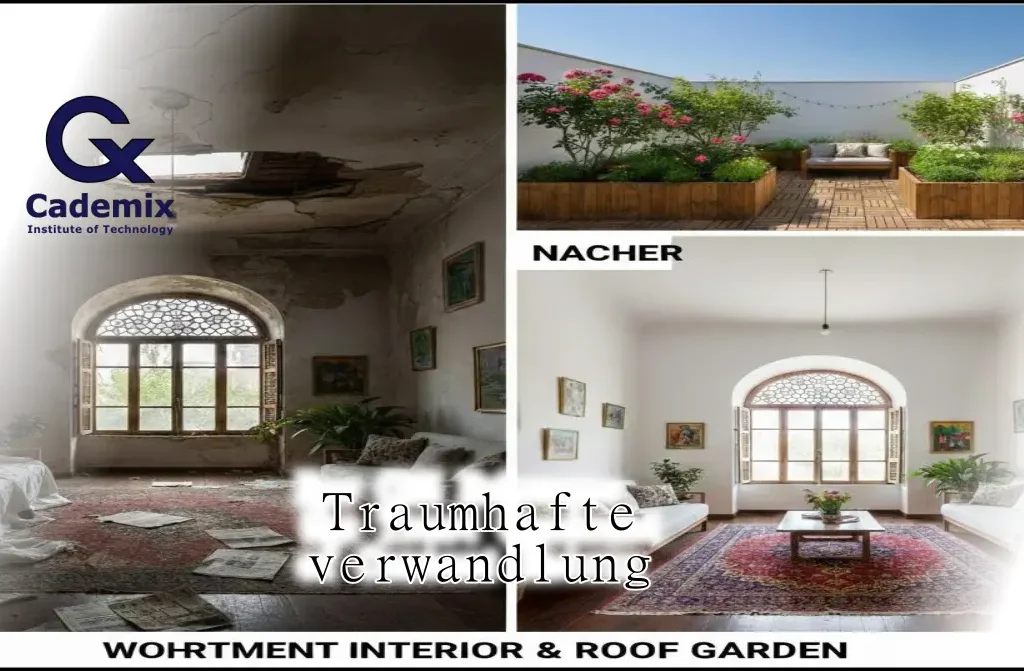
Die Renovierung dieses Gebäudes zeigt, dass Bestandserneuerung weit mehr sein kann als eine technische Notwendigkeit. Sie ist eine nachhaltige Strategie zur Stadtentwicklung, zur Ressourcenschonung und zum Erhalt kultureller Identität.
Dieses Projekt verdeutlicht, dass Renovierung dann besonders erfolgreich ist, wenn sie mit Respekt vor dem Bestehenden, klaren Zielen und einem langfristigen Qualitätsanspruch durchgeführt wird. Gerade im österreichischen Kontext, in dem historische Bausubstanz einen hohen Stellenwert besitzt, ist diese Herangehensweise von besonderer Bedeutung.
Renovierung ist in diesem Sinne kein Kompromiss, sondern eine bewusste Entscheidung für Qualität, Verantwortung und Kontinuität.
Die in diesem Artikel beschriebene Renovierung zeigt exemplarisch, welches Potenzial in der bewussten Arbeit mit dem Bestand liegt. In einer Zeit, in der Ressourcenknappheit, Klimaziele und städtebauliche Verdichtung zunehmend an Bedeutung gewinnen, wird Renovierung zu einer zentralen architektonischen Aufgabe. Zukünftige Projekte werden noch stärker darauf angewiesen sein, bestehende Strukturen intelligent weiterzuentwickeln, anstatt sie zu ersetzen. Die hier gewonnenen Erfahrungen bestätigen, dass eine präzise Analyse, eine klare konzeptionelle Haltung und interdisziplinäre Zusammenarbeit die entscheidenden Voraussetzungen für qualitätsvolle und nachhaltige Renovierung sind.
1) EU-Gebäuderichtlinie – Energy Performance of Buildings Directive (EPBD)
Aktuelle EU-Richtlinie zur Gesamtenergieeffizienz von Gebäuden mit Renovierungszielen, Mindeststandards und nationalen Renovierungsplänen. Enthält Vorgaben zur Energieeffizienz bei Renovierungen.
https://en.wikipedia.org/wiki/Energy_Performance_of_Buildings_Directive_2024
2) National Building Renovation Plans – EU Kommission
Offizielle Seite der EU-Kommission zu nationalen Sanierungsplänen. Verpflichtet Mitgliedstaaten zur langfristigen Strategie für Renovierung und Dekarbonisierung des Gebäudebestands bis 2050.
https://energy.ec.europa.eu/topics/energy-efficiency/energy-performance-buildings/national-building-renovation-plans_en
3) Energieeinsparverordnung (EnEV) / Gebäudeenergiegesetz (GEG) – Germany
Regelwerk zu Mindestenergieanforderungen bei Neubau und Renovierung in Deutschland; EnEV durch GEG ersetzt, gilt für Energieeffizienz im Gebäudebereich.
https://en.wikipedia.org/wiki/Energieeinsparverordnung
4) OIB-Mindeststandards Energieeffizienz & Renovierungspässe – Österreich
Österreichische Informationsseite zu Mindeststandards der Gebäudeenergieeffizienz, Renovierungspässen und strategischen Renovierungsplänen gemäß EU-Gebäuderichtlinie.
https://www.oib.or.at/nicht-kategorisiert/mindeststandards-fuer-die-energieeffizienz-renovierungspaesse-und-nationaler-gebaeuderenovierungsplan-in-der-neuen-eu-gebaeuderichtlinie-folge-1-von-2
5) EU-Richtlinie zur Gesamtenergieeffizienz von Gebäuden – Energieverbraucher.de
Erklärung zur Energieeffizienzrichtlinie und zu Anforderungen bei größeren Renovierungen (Mindestenergieeffizienz bei Bestandserneuerung).
https://www.energieverbraucher.de/de/gebaeuderichtlinie__415/
6) Gebäuderichtlinie (EPBD) – Gebaeudeforum.de
Übersicht zu den zentralen Vorgaben der EU-Gebäuderichtlinie, darunter Renovierungspässe, Effizienzanforderungen sowie technische Normen (z. B. Energieausweis, Gebäudeautomation).
https://www.gebaeudeforum.de/ordnungsrecht/eu-vorgaben/epbd/
7) European Green Deal – EU-Klimaschutzprogramm
Überblick über die EU-Strategie zur Dekarbonisierung, inklusive ambitionierter Ziele für Renovierung und Energieeffizienz des Gebäudebestands.
https://en.wikipedia.org/wiki/European_Green_Deal
8) German National Action Plan on Energy Efficiency (NAPE)
Nationaler Aktionsplan Deutschlands zur Energieeffizienz, der auch energieeffiziente Renovierung im Gebäudesektor adressiert; Basis u. a. EU-Energy-Efficiency-Directive.
https://en.wikipedia.org/wiki/German_National_Action_Plan_on_Energy_Efficiency
9) Passive House / EnerPHit Standard (Weltweit anerkannt)
Standard für hohe Energieeffizienz im Neubau und bei Renovierungen (EnerPHit = Passivhaus-Konzept für Bestandsgebäude), relevant für energieeffiziente Renovierungspraxis.
https://en.wikipedia.org/wiki/Passive_house
10) Wikipedia – Energieeffizienzrichtlinie (EED)
EU-Richtlinie zur Energieeffizienz (EED), Teil des gesetzlichen Rahmens, der Renovierungsanstrengungen im Gebäudesektor unterstützt.
https://en.wikipedia.org/wiki/EU_Energy_Efficiency_Directive_2012

I built this project with Power BI to make Eurostat’s Harmonised Index of Consumer Prices (HICP) easier to explore in a way that is both comparative (across countries/regions) and decomposable (down into category, year, quarter, and month). The core deliverable is a Power BI report backed by a semantic model. The model standardizes time handling, country labeling, and category ordering so the visuals behave predictably under slicing and drill-down.
On top of the report, I added a lightweight Streamlit application as a companion UI. It reuses the same conceptual structure date range, country/region filters, COICOP categories, and metric selection in a web-first layout.
The result is a workflow where the Power BI file is the analytical source of truth for modeling and curated visuals, while the Python app offers an alternate way to browse the same series with a narrower deployment surface. The emphasis is not on novelty, but on engineering discipline in data shaping, metric definitions, and interaction design across two runtimes.
Saber Sojudi Abdee Fard
When inflation spikes or cools, the first question is usually not “what is the number,” but “where is it coming from, and how does it compare.” I built this dashboard around that workflow: start from an overview (index and inflation rate trends across selected countries/regions), then move into composition (category contributions and drill paths), and finally allow per-country “profile pages” that summarize the category landscape for a given period.
A second requirement was practical reproducibility. The Power BI report is the main artifact, but I also added a small Streamlit app so the same dataset can be explored outside the Power BI desktop environment. The intent is not to replace the report; it is to provide a simpler, web-native view that preserves the same filter semantics and metric definitions.
I kept the scope deliberately tight so the visuals remain interpretable under interactive filtering. The report focuses on a curated set of countries/regions and a small COICOP subset that supports stable labeling and ordering, rather than attempting to be a full Eurostat browser. The time grain is monthly and the primary series is the HICP index (2015=100), with inflation rates treated as derived analytics over that index. I also treat “latest” values as a semantic concept (“latest month with data in the current slice”) instead of a naive maximum calendar date, because empty tail months are common in time-series exploration.
This project is not a forecasting system and it does not attempt causal attribution of inflation movements. It also does not try to reconcile HICP movements against external macro variables or explain policy drivers. The Streamlit app is not intended to reproduce every Power BI visual; it is a companion interface that preserves the same filter semantics and metric definitions in a web-first layout.
The model is designed around a single canonical grain: monthly observations keyed by (Date, geo, coicop). In Power BI, DimDate represents the monthly calendar and facts relate to it via a month-start Date column; DimGeo uses the Eurostat geo code as the join key with a separate display label (Country); and DimCOICOP uses the Eurostat coicop code as the join key with a separate display label (Category) and an explicit ordering column. Facts are intentionally narrow and metric-specific (index levels, inflation rates, weights), but they share the same slicing keys so a single set of slicers can filter the entire model consistently.
The Streamlit app enforces an equivalent contract at ingestion. It expects a monthly index table that can be normalized into: year, month, geo, geo_name, coicop, coicop_name, and index, plus a derived date representing the month start. Inflation rates are computed from the index series within each (geo, coicop) group using lagged values (previous month for MoM, 12 months prior for YoY), which implies a natural warm-up period: YoY values are undefined for the first 12 months of any series.
On the Power BI side, I structured the model around an explicit start and end month (as text parameters) so the report can generate a consistent monthly date spine and align all series to the same window. This choice simplifies both the UX (one date range slider) and the model logic (all measures can assume a monthly grain without defensive checks for mixed frequencies).
The dataset is handled via Power Query (M) with a “flat table” approach for facts: each table carries the keys needed for slicing (time, geography, COICOP category) and a single numeric value column per metric family (index, rates, weights). At the report layer, measures are responsible for turning these fact values into user-facing metrics and “latest” summaries in a way that respects slicers.
I modeled the dataset as a star schema to keep filtering deterministic and to avoid ambiguous many-to-many behavior. The design uses a small set of dimensions (Date, Geography, COICOP category) and multiple fact tables specialized by metric type (index levels, month-over-month rate, year-over-year rate, and weights). This separation lets each table stay narrow and avoids overloading a single wide fact table with columns that do not share identical semantics.
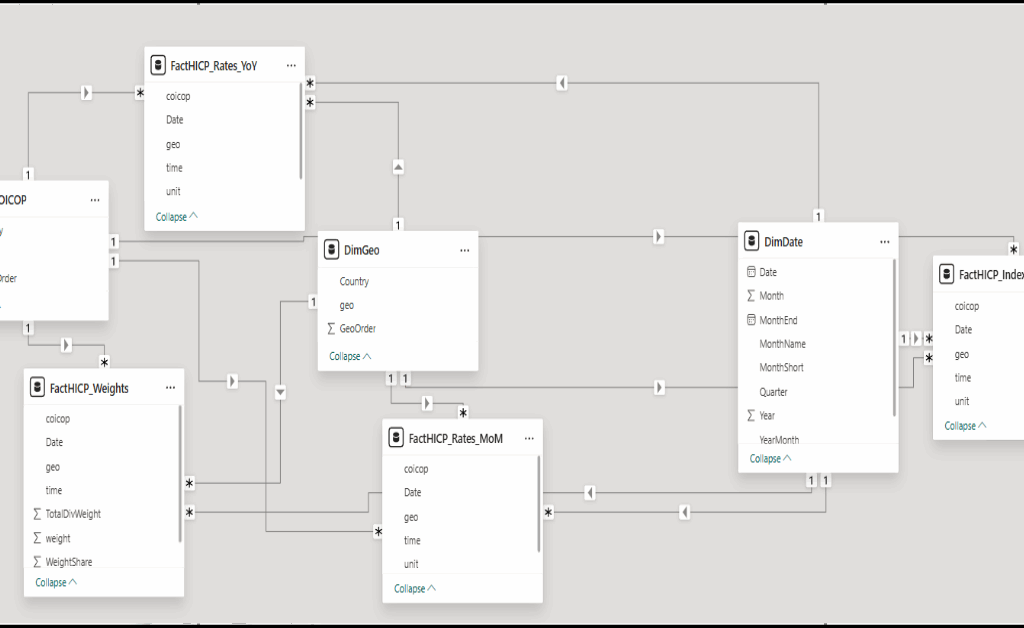
Figure 1: The semantic model is organized as a star schema with Date/Geo/COICOP dimensions filtering dedicated fact tables for index, rates, and weights.
To keep the report consistent across visuals, I centralized calculations into measures. At the base, index values are aggregated from the index fact. Inflation rates are computed as ratios (current index over lagged index) minus one, expressed as percentages. This makes the definition explicit, auditable, and consistent with the time grain enforced by the date dimension.
For “latest” cards/bars, I avoid assuming that the maximum date in the date table is valid for every slice. Instead, a dedicated “latest date with data” measure determines the most recent month where the base metric is non-blank under the current filter context, and the latest-rate measures are defined as the metric evaluated at that date. This prevents misleading “latest” values when a user filters to a subset where some months are missing.
To keep the date slicer from extending beyond the available series, I also apply a cutoff mechanism: a measure computes the maximum slicer date (end of month before the latest data), and a boolean/flag measure can be used to hide dates beyond that cutoff. This improves the interaction quality because users are not encouraged to select an “empty” tail of months.
The report is organized around a small set of high-signal experiences:
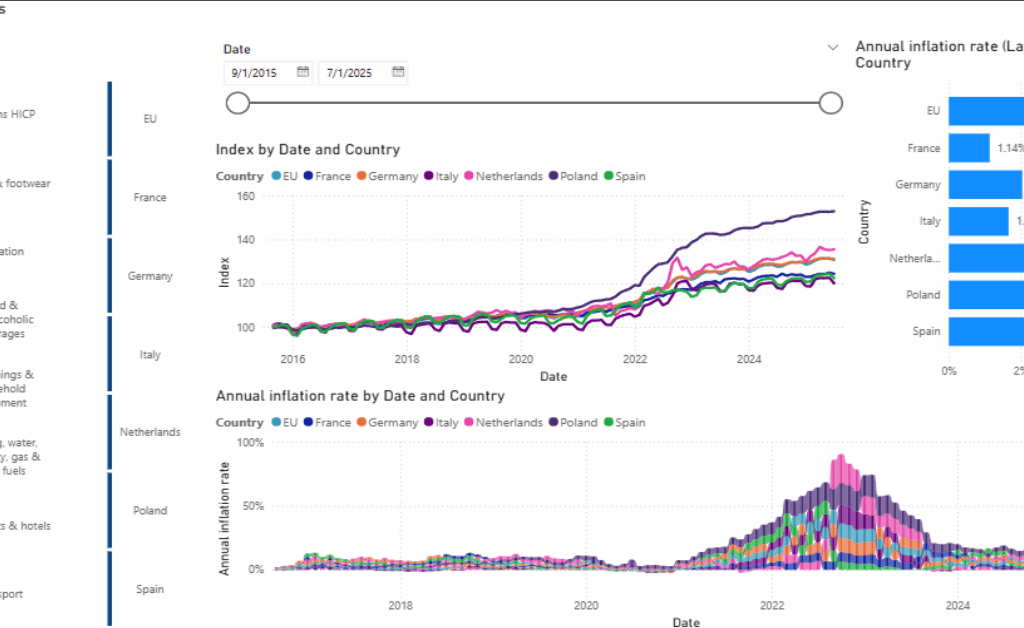
Figure 2: Overview layout: date filtering and COICOP selection drive index and inflation charts, with a “latest annual inflation rate” bar for quick comparison.
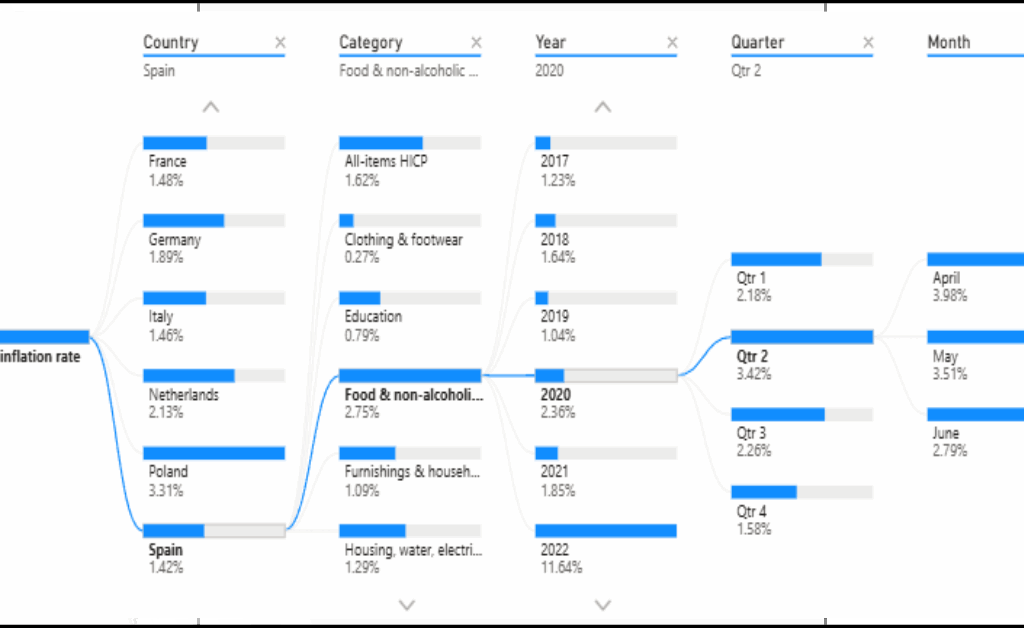
Figure 3: Decomposition path: annual inflation rate is broken down stepwise by country, category, and calendar breakdowns to reach month-level context.
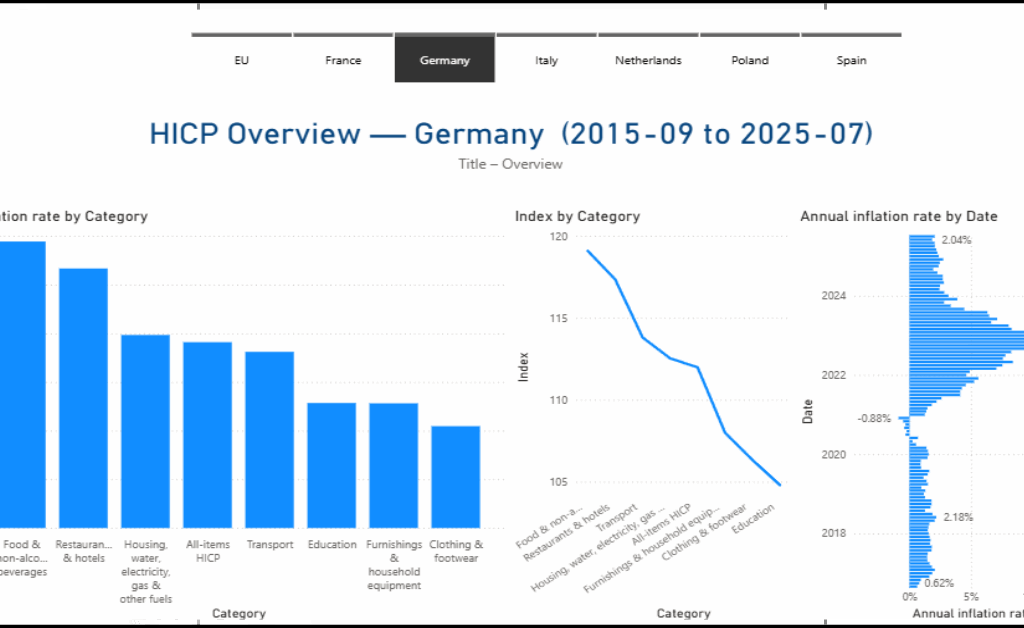
Figure 4: Country view: a dedicated overview page summarizes category inflation, category index levels, and the time distribution of annual inflation for one country.
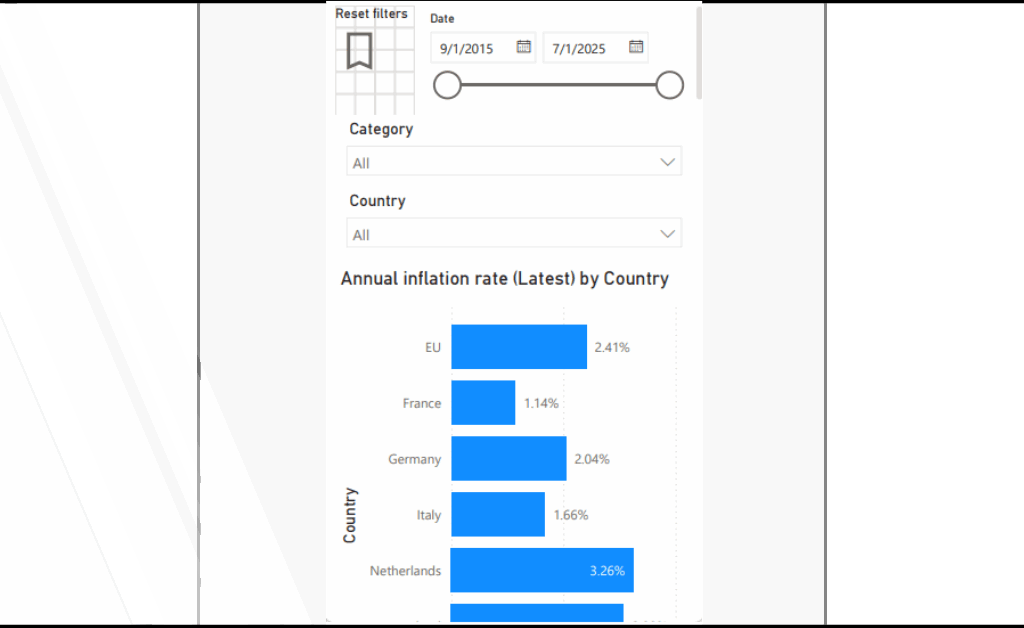
Figure 5: Mobile-focused view and Streamlit companion UI: a compact “latest annual inflation rate by country” experience paired with a simplified filter panel. a filter-first sidebar and tabbed exploration views for annual YoY series, index trajectories, and supporting tables.
The Streamlit app mirrors the report’s mental model: choose a date range, countries/regions, COICOP categories, and then explore one of several views (annual rate, monthly rate, index trajectories, and supporting tabular outputs). I designed it as a small module set: a main entrypoint for page layout and routing, helper utilities for data prep, a filters module to standardize selection logic, and a tabs module to keep view-specific plotting code isolated.
For correctness, the app also includes a simple “guardrails” strategy: it flags implausible month-over-month values (for example, extreme outliers) rather than silently accepting them. This is not a substitute for upstream data quality work, but it is a practical way to prevent a single malformed row from dominating a chart in an exploratory UI.
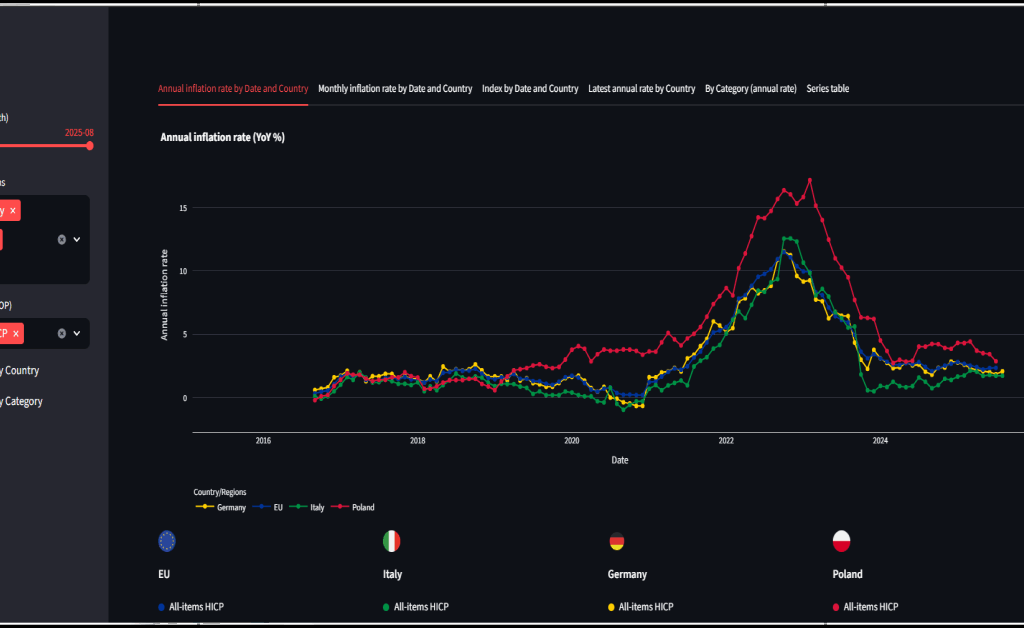
Figure 6: Streamlit companion UI: a filter-first sidebar and tabbed exploration views for annual YoY series, index trajectories, and supporting tables.
The Power BI deliverables are hicp_eu27.pbip / hicp_eu27.pbix. The semantic model metadata is stored under hicp_eu27.SemanticModel/definition/, and the report metadata is stored under hicp_eu27.Report/.
Core analytics are centralized in measures. The model defines base measures such as Index, Monthly inflation rate, and Annual inflation rate, and it also implements “latest-with-data” semantics through Latest Date (with data) and Annual inflation rate (Latest).
Time filtering is kept honest through explicit cutoff logic. Measures such as Max Slicer Date and Keep Date (≤ cutoff) prevent visuals and slicers from drifting into months that exist in the date table but do not have observations in the selected slice.
Report visuals are defined explicitly in the report metadata. In practice, the report uses a line chart for index trends, a ribbon chart for annual inflation over time, a clustered bar chart for latest annual inflation comparisons, a decomposition tree for drill paths, and tabular visuals for series browsing.
The Streamlit companion app uses app/main.py as the entry point, with app/tabs.py, app/filters.py, and app/helpers.py separating view logic, filtering semantics, and shared UI utilities. Static flag assets are stored under app/flags/.
I designed the interaction model around how people typically reason about inflation: compare, drill, and then contextualize. The overview experience prioritizes side-by-side comparisons across countries/regions over a shared date range, with a small number of visuals that answer distinct questions: the index trajectory (level), the inflation rate trajectory (change), and a “latest” comparison (current snapshot). Slicers are treated as first-class controls date range, country/region, and COICOP category and the model is structured so those slicers propagate deterministically across all visuals.
For decomposition, I use an explicit drill path rather than forcing the reader to infer breakdowns across multiple charts. The decomposition view starts at an annual inflation rate and allows stepwise refinement through country, category, and calendar breakdowns (year → quarter → month), so the reader can move from headline behavior to a specific period and basket component without losing context. The per-country pages then act as “profiles”: once a country is selected, the visuals shift from comparison to composition, summarizing category differences and the distribution of annual rates over time.
In the Streamlit app, the same interaction principles are implemented as a filter-first sidebar plus tabbed views. Tabs separate the mental tasks (YoY trends, MoM trends, index levels, latest comparisons, and an exportable series table), while optional toggles control how series are separated (by country, by category, or both) to keep multi-series charts readable as the selection grows.
The primary success criterion for this project is interaction correctness: slicers and filters must produce coherent results across different visual types without requiring users to understand measure-level details. In practice, the report behaves as intended in three “validation checkpoints.”
First, the overview page supports side-by-side country comparisons over a single monthly date range, while remaining stable under COICOP category selection. The index plot and inflation-rate visuals update together, and the “latest annual inflation rate” bar chart remains meaningful because “latest” is defined by data availability rather than by the maximum calendar month.
Second, the decomposition view provides an explicit reasoning path from a headline annual rate into a specific country/category and then into calendar breakdowns. This reduces the need to mentally join multiple charts: the drill path is encoded in the interaction itself.
Third, the per-country overview pages turn a filtered slice into a “profile” that is easy to read: which categories have higher annual inflation, how category indices compare, and how annual inflation distributes over time. This design is particularly useful when the user wants to compare the shape of inflation dynamics across countries rather than just comparing single-point estimates.
A recurring design trade-off in this project is where to place logic: in Power Query, in the semantic model, or in the application layer. I chose to keep the facts relatively “raw but standardized” (keys + numeric values) and then express most analytic intent in measures. That makes the metric definitions inspectable and reduces the risk that a transformation silently diverges from what the visuals imply.
Another trade-off is scope control. The model is deliberately constrained to a set of countries/regions and COICOP categories that support clean ordering and readable comparisons. This improves the story and the UI, but it also means the model is not a general-purpose Eurostat browser. If I were productizing this, I would likely add a “wide mode” that dynamically imports more categories and geographies, alongside a curated “core mode” that preserves the current report design.
Finally, the Streamlit app demonstrates portability, but it also introduces the need to keep metric definitions aligned across two runtimes. I mitigated this by mirroring the report’s concepts (metrics, filters, and guardrails) rather than trying to recreate every Power BI visual. The app is most valuable when it stays narrow: fast slicing, clear trend lines, and a readable series table.
(Date, geo, coicop).MAX(Date). I used “latest-with-data” for KPIs.This project is a compact example of how I approach analytics engineering: define a stable monthly grain, build a star schema that filters cleanly, centralize metric semantics in measures, and design visuals around the user’s reasoning path rather than around chart variety. Power BI is the primary artifact, and the Streamlit app is a pragmatic companion that reuses the same filter-and-metric concepts in a web-first UI.
The next step is straightforward: document the model decisions (especially “latest” semantics and cutoff logic) directly inside the repo, and decide whether the Streamlit app should read from an exported model snapshot or from a shared data extraction step to reduce drift risk.
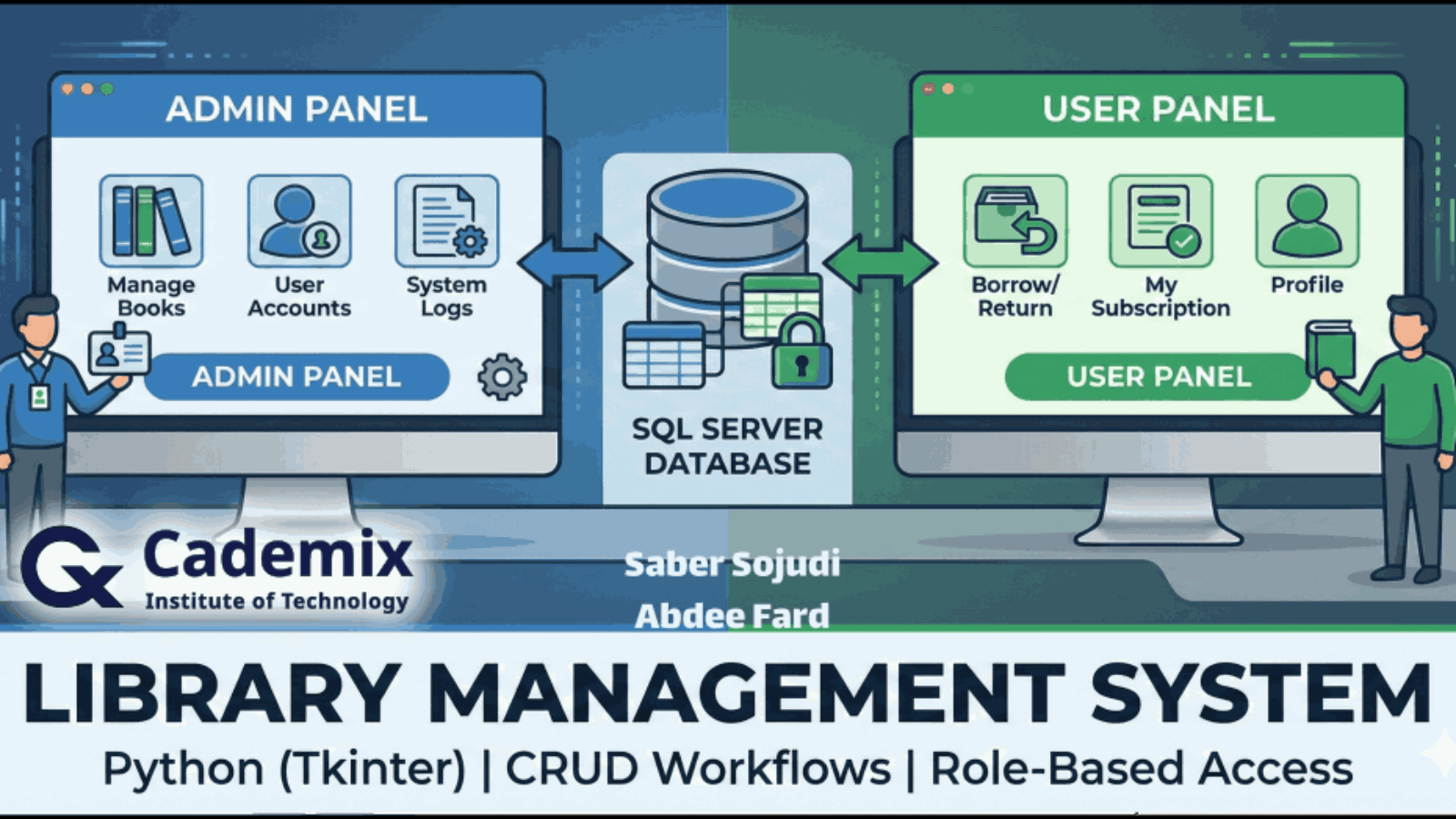
I built a Python/Tkinter desktop application to demonstrate core library-management workflows. The application uses Microsoft SQL Server as its backend and connects via pyodbc through a 64-bit Windows System DSN configured for the SQL ODBC driver stack (ODBC Driver 17). The project is organized around typical CRUD operations for library entities and operational flows such as account management and book circulation. The intended end-to-end flows include database initialization, role-based login (admin and user), user registration, adding books, borrowing and returning books, suspending and releasing users, and renewing subscriptions; these flows are described as intended behavior rather than personally validated execution. During implementation, I addressed practical reliability issues commonly encountered in local SQL Server development, including driver encryption settings (e.g., TrustServerCertificate), safe handling of GO batch separators in SQL scripts, and rerunnable (idempotent) table creation. The design also reflects the realities of schema dependency management, such as foreign key ordering and constraint-driven creation/seeding. The project scope is intentionally limited to a single-machine desktop deployment; it is not a web application and does not include an automated test suite.
Saber Sojudi Abdee Fard
I built this Library Management System as a desktop-first, database-backed application to exercise the full path from relational modeling to application integration. The core goal is not a “feature-rich library product,” but a clear demonstration of schema design, referential integrity, and CRUD-style workflows exposed through a Tkinter GUI while persisting state in Microsoft SQL Server.
A deliberate early design choice was to treat local developer setup as part of the system, not an afterthought. The project assumes a Windows 64-bit environment and a SQL Server instance (Express/Developer) reachable via a 64-bit System DSN named SQL ODBC using ODBC Driver 17. For local development, the documentation explicitly calls out the common encryption friction point with Driver 17 and suggests either disabling encryption or enabling encryption while trusting the server certificate, which aligns with the reliability lessons captured in the project snapshot.
At the data layer, the schema is centered around a small set of entities Publisher, Category, Book, Member, Transactions, and User_tbl that together model catalog metadata, membership identity, subscription validity, and circulation events. In the ERD, Book references both Publisher and Category (one-to-many in each direction), and Transactions acts as the operational log linking a Member to a Book with dates for borrowing/returning (including due/return dates). The design also separates member identity (Member) from subscription state (User_tbl) through a one-to-one relationship, which is a simple way to keep “who the user is” distinct from “membership validity.”
This project’s scope is intentionally bounded. It is not a web application, it assumes a single-machine DSN-based setup, and it does not include an automated test suite; the project documentation frames it as an educational implementation rather than a production-hardened system.
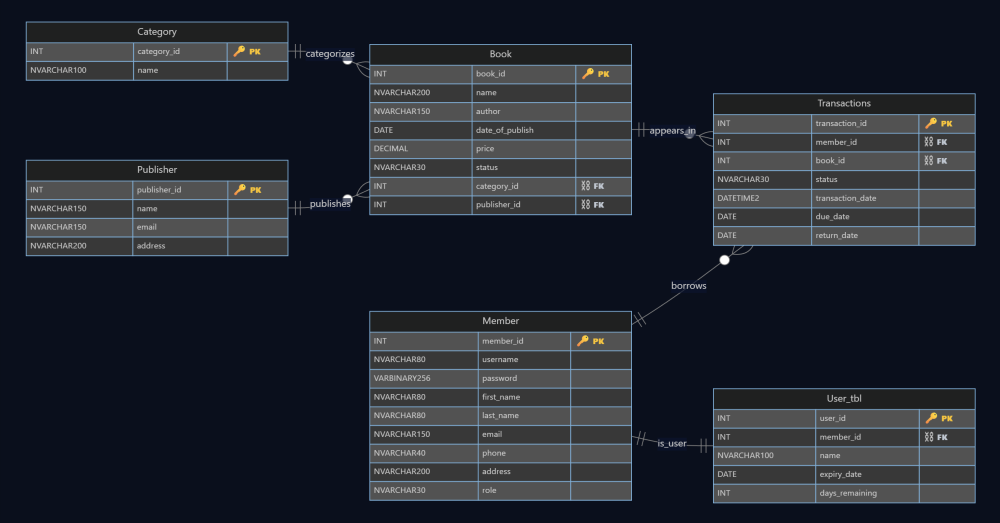
Figure 1 The schema backbone: books are categorized and published, transactions record borrow/return activity, and membership validity is separated into a dedicated subscription table.
I treated the database as a first-class subsystem rather than an opaque dependency, because most of the application’s correctness depends on consistent schema state and predictable connectivity. The project standardizes connectivity through a Windows 64-bit System DSN named SQL ODBC, and uses pyodbc to open a cursor against a fixed target database (LibraryDB). The connection string is explicit about the common ODBC Driver 17 development friction: encryption can be disabled (Encrypt=no) for local development, or enabled with TrustServerCertificate=yes depending on the developer’s environment and SQL Server configuration. This decision aligns with the project’s “single-machine DSN setup” scope and keeps runtime behavior deterministic across scripts.
To avoid duplicating boilerplate across many standalone Tkinter scripts, I centralized the lowest-level helpers in utils.py. In practice, that file functions as the project’s shared “platform layer”: it owns DB cursor creation, input validation helpers (email/phone), and the password hashing helper used in account creation and bootstrapping.
The schema can be created in two ways, which gives the project a pragmatic “belt and suspenders” setup story:
table_creation.py) checks information_schema and sys.indexes before creating base tables and indexes. If any required table is missing, it creates the full set (publisher, book, category, member, subscription table, and transactions) and then builds secondary indexes to support common lookup paths such as book title, author, and member username. The same script separately applies named foreign key constraints (with cascade behavior) only if they do not already exist, and it bootstraps a default admin account if one does not exist. This “check-then-create” approach makes schema creation re-runnable without failing on already-created objects, which is the project’s main safeguard against re-run failures during iterative development.run_sql_folder.py) executes the .sql files in numeric order (e.g., 1-...sql, 2-...sql) and explicitly supports GO batch separators by splitting scripts into batches using a regex. This matters because GO is not a T SQL statement; it is a client-side batch delimiter, and without pre-processing it will typically break naïve executors. The runner therefore converts a folder of SQL scripts into reliably executable batches and commits each batch.A related helper exists in utils.py (insert_data_to_tables) that attempts to seed tables by scanning the current directory for .sql files, splitting on semicolons, and executing statements when the target table is empty (or near-empty). This provides a lightweight seeding mechanism, but it is intentionally less strict than the GO-aware runner; in the article, I will describe it as a convenience seeding helper rather than the primary “authoritative” database migration mechanism.
At the schema level, the database design enforces core invariants in the table definitions and constraints: book.status is constrained to a small enumerated set (“In Stock”, “Out of Stock”, “Borrowed”), member.role is constrained to (“Admin”, “User”), and subscription status is constrained to (“Valid”, “Suspend”). The explicit constraints simplify application logic because invalid states are rejected at the database boundary rather than being “soft rules” in UI code.
The application’s entrypoint (login.py) is more than a UI screen it also acts as a bootstrapping coordinator that ensures the database is in a usable state before any authentication decision is made. At startup, initialize_database() calls the schema and index creation routines, provisions a default admin account, attempts to seed data, and then applies foreign key constraints. This sequencing is intentional: it makes first-run setup largely self-contained and reduces “works only after manual SQL setup” failure modes, while still keeping the overall system aligned with a local SQL Server development workflow.
Once initialized, the login flow uses a simple but explicit contract: the user submits a username and password, selects a role from a dropdown (“Admin” or “User”), and the application verifies both credentials and role alignment against the database record. The code fetches the member row by username, hashes the entered password, and compares it to the stored hash. It then enforces a role gate: an admin account cannot enter through the “User” route, and a user account cannot enter through the “Admin” route. This guards the navigation boundary between admin and user panels without relying on hidden UI conventions.
The account creation path is implemented as a separate Tkinter screen (create_account.py) that inserts a new member with role fixed to User. Before insertion, it validates required fields, checks that the password confirmation matches, and uses shared validators for email format and phone number format. It also checks username uniqueness with a query that counts existing rows grouped by username, and it refuses registration if the username is already taken. Successful registration writes the new member record and clears the form fields to avoid accidental duplicate submissions.
Password reset is implemented as a lightweight “forgot password” screen (forgetpassword.py). The flow is intentionally minimal: given a username and a new password (with confirmation), it verifies that the username exists in member, then updates the stored password hash. This keeps credential recovery self-contained inside the same data model as login and avoids separate recovery tables or email workflows, which fits the project’s desktop-scope constraints.
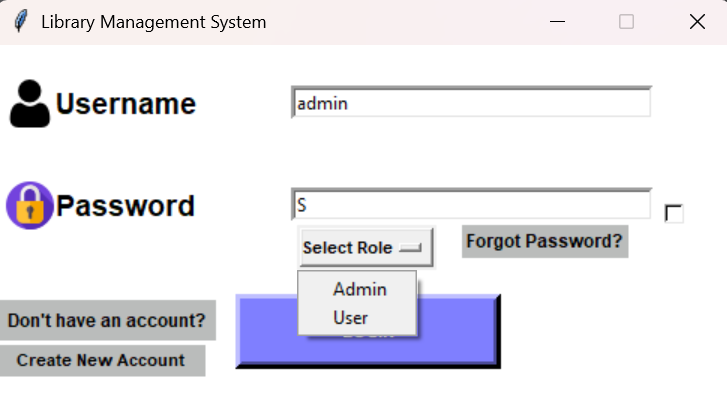
Figure 2 The login boundary: users authenticate with a username/password and explicitly choose Admin vs User, which is checked against the stored role before routing to the relevant panel.
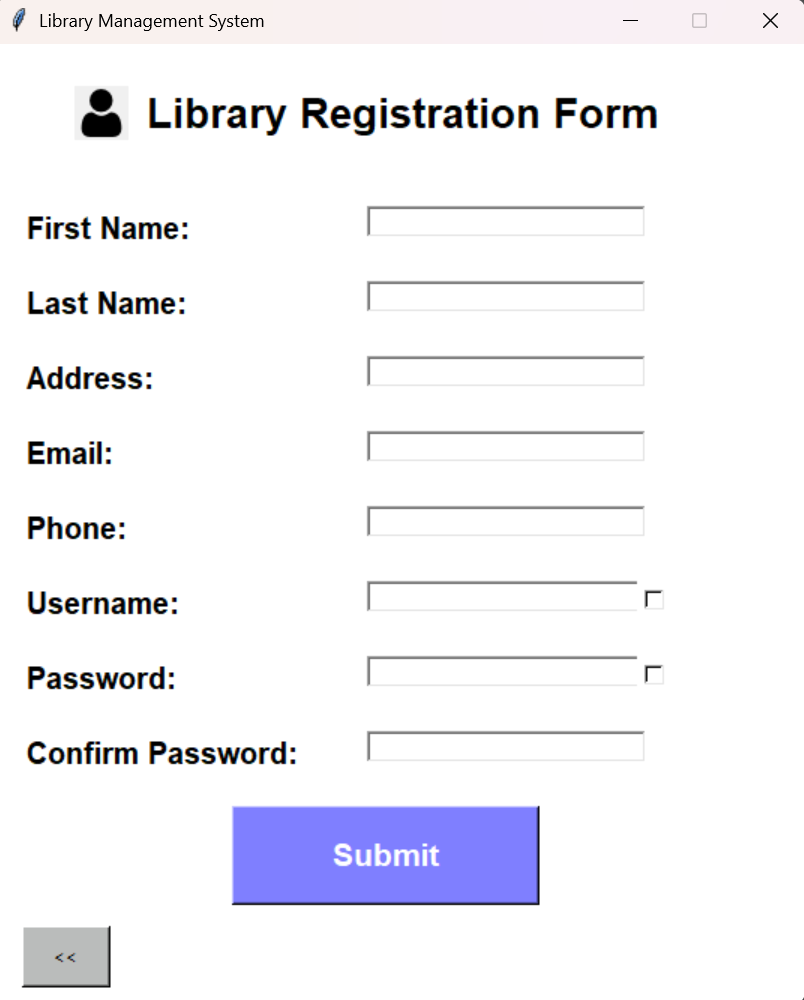
Figure 3 User registration captures member identity fields and applies basic validation before inserting a member record with role set to User.
After authentication, the application routes the user into one of two role-specific control surfaces: an admin panel for operational control and a user panel for day-to-day library usage. I implemented these as distinct Tkinter windows, each acting as a small navigation hub that dispatches into focused, single-purpose screens. This “screen-per-script” structure keeps each workflow isolated and reduces the cognitive load of large, monolithic UI modules.
On the admin side, admin_panel.py provides entry points to the book catalog view, user list view, user suspension view, and the admin’s own profile page, plus a guarded logout action that requires confirmation before returning to the login window. The panel itself does not implement the workflows; it acts as a router that destroys the current window and transfers control to the relevant module. That pattern is consistent across the codebase and is the main way UI state is managed without a central controller.
On the user side, user_panel.py is intentionally narrower: it routes to subscription management, borrowing, returning, and the user profile. It passes a user_id (member_id) across windows as the primary identity token for user-scoped operations. This aligns with the schema design: member_id is the stable key for linking identity to circulation and subscription state, and the UI reuses that same key for most user flows.
Profile views for both roles follow the same implementation model: read from the member table using a parameterized query, then render the result in a ttk.Treeview. Admin profile lookup is username-based, while user profile lookup is member_id-based; both approaches are consistent with how the rest of the UI passes identity around (admins are handled by username at entry, users by id after login). The profile screens also provide an “Edit Profile” action that transitions into a dedicated edit form.
The edit forms (admin_edit_profile.py and user_edit_profile.py) are implemented as partial-update screens: they collect only the fields the user actually filled in and then execute one UPDATE statement per field. This is a pragmatic way to avoid overwriting existing values with empty strings and it makes the update logic easy to reason about. The user edit screen additionally routes email and phone through explicit validators before updating the database. Password changes are stored as a hash in the same field used by login, keeping credential semantics consistent across registration, editing, and recovery.
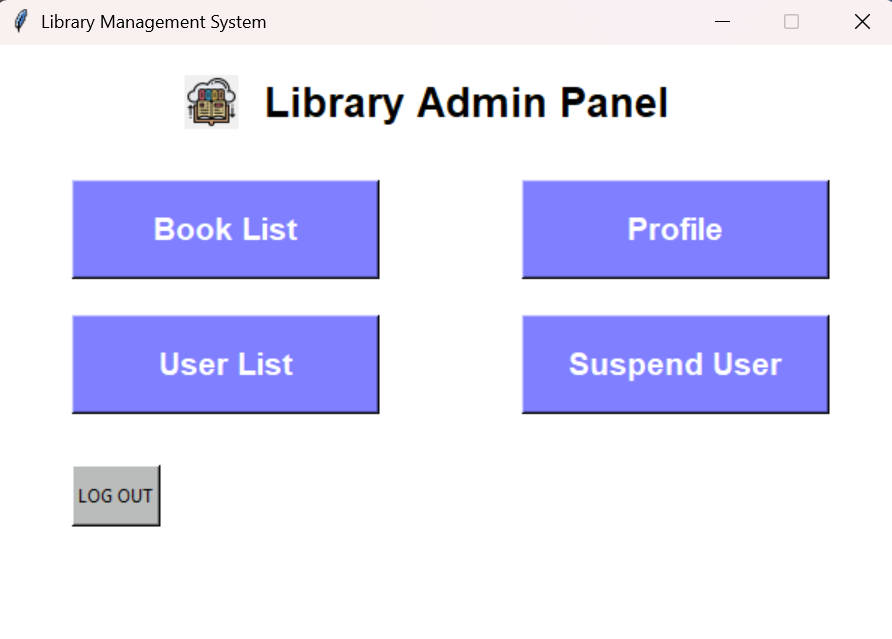
Figure 4 The admin control surface routes into operational workflows (catalog management, user list, and suspension) without embedding the business logic in the panel itself.
The core “library” behavior in this project is implemented as a set of focused screens that sit directly on top of a small number of database tables: book and publisher for the catalog, category for book categorization, and transactions for circulation history. Rather than hiding SQL behind a separate repository layer, these modules keep the database interaction close to the UI event handlers, with parameterized queries and explicit commits. That choice makes the data flow easy to trace in a learning-oriented codebase: button click → query/update → refreshed view.
On the admin side, booklist.py provides the catalog “truth view” using a join across book, publisher, and category. The query pulls the book’s identity, price, publisher, author, status, and category name(s), and then populates a ttk.Treeview. Because the category table can contain multiple rows per book_id, the code includes a post-processing step that merges categories for the same book into a single display value so the list behaves like a denormalized catalog view without losing the underlying row-level representation. Search is implemented as a set of narrow SQL variants (name, author, publisher, status, category) driven by a radio-button selector, and removal explicitly deletes dependent category rows before deleting the book row to avoid foreign key conflicts.
Adding a book (addbook.py) is implemented as a two-step write that mirrors the schema. The admin enters book metadata plus a publisher name and a category name. The screen first resolves publisher_id by publisher name, inserts a new row into book with an initial status of "In Stock" and a publish date, and then inserts a category row pointing back to the created book_id. In this design, “category” behaves like a book-to-category association table (even though it is named category), which is consistent with how the list view joins categories back onto books.
On the user side, circulation is tracked as an append-only event stream in transactions with a mirrored “current availability” indicator stored in book.status. Borrowing (borrowBook.py) checks the selected row’s inventory status and only proceeds when the book is "In Stock". A successful borrow inserts a "Borrow" transaction for the current member_id and updates the corresponding book.status to "Borrowed". Returning (bookReturn.py) reconstructs the user’s currently borrowed set by counting "Borrow" versus "Return" events per book_id; it displays only those books with exactly one more borrow than return, and a return action records a "Return" transaction and restores the book’s status to "In Stock". The return screen also computes a simple cost estimate as a function of days since the borrow transaction date, which demonstrates how transactional history can drive derived UI metrics.
A few small contracts hold this together cleanly:
book.status as the immediate guard for whether a book can be borrowed, using "In Stock" as the only borrowable state.transactions provides a history (“Borrow”/“Return”), while book.status provides the current snapshot for fast display and filtering.member_id (passed into the screens as user_id) for all transaction writes and reads.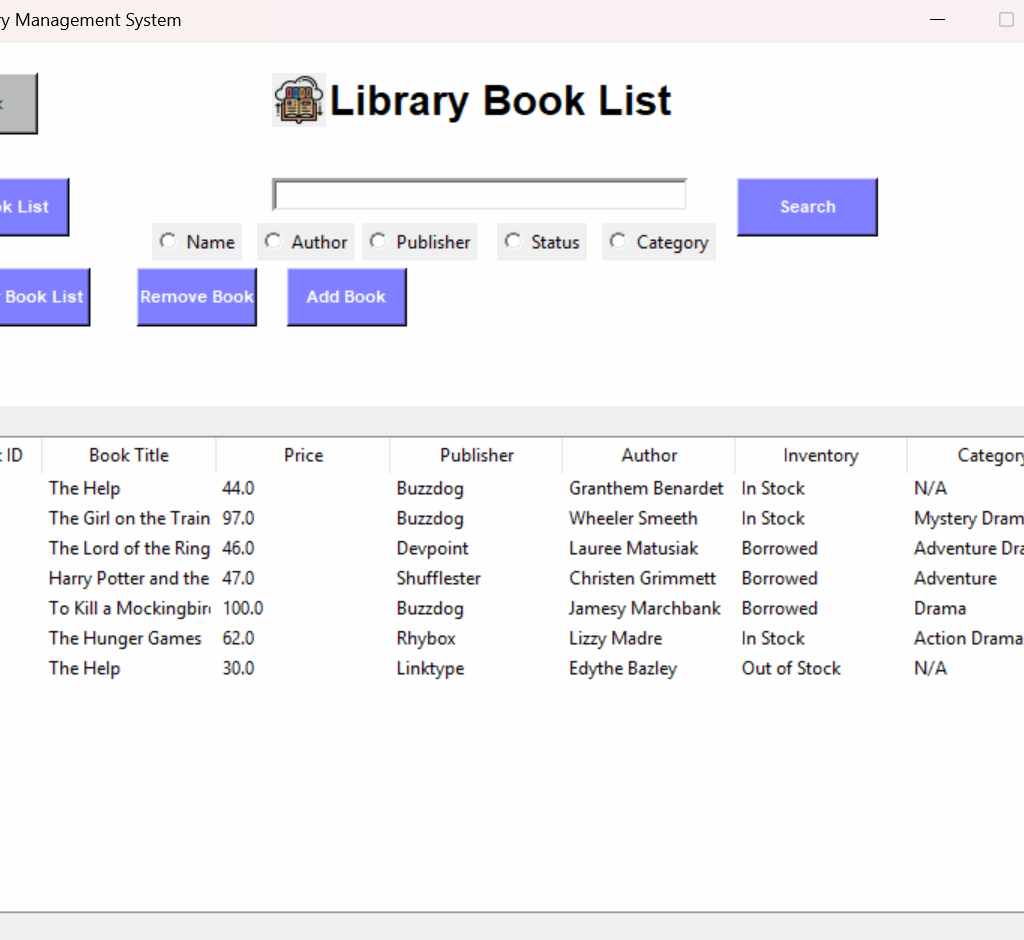
Figure 5 The catalog view surfaces the join of book metadata, publisher, category, and availability status, and it is the main UI surface that reflects the current database state.
Beyond catalog and circulation, the project includes a small set of “operations” screens that make membership state explicit and controllable. I kept this logic close to the database tables that represent it: user_tbl stores subscription validity and an expiration date, while member stores identity and role. The UI surfaces these as two complementary control planes: users can extend their own validity period, and admins can inspect, remove, or suspend accounts.
The user-facing subscription screen (subscription.py) treats expire_date as the canonical definition of remaining time. It fetches the user’s current expiration date from user_tbl, computes remaining days relative to date.today(), and displays that countdown prominently. Renewal is implemented as an additive operation: pressing a 3-month, 6-month, or 1-year button adds a relativedelta(months=...) offset to the existing expiration date and writes it back with an UPDATE on the current member_id. This design is intentionally simple: it preserves history in the sense that renewals are always cumulative, and it avoids hard resets that could unintentionally shorten a membership.
On the admin side, userList.py provides an inspection and maintenance view over library accounts by joining member with user_tbl and listing both identity fields and the current status value. From there, the admin can (a) load the full list of valid/suspended users, (b) suspend a selected user by setting user_tbl.status to 'Suspend', and (c) remove a selected user entirely. Removal is implemented as an explicit dependency-ordered delete: the code deletes the user’s transactions first, then the associated user_tbl record, and finally the member record, and then refreshes the listing. Even in a small project, this ordering matters because it aligns with foreign-key dependencies and prevents the most common “cannot delete because it is referenced” failure mode.
Suspended-user management is separated into its own screen (suspendedUsers.py) rather than being an overloaded state inside the main user list. That module filters the join to only users with status 'Suspend', displays them in a table, and provides a “Release User” operation that restores user_tbl.status back to 'Valid'. This split keeps the administrative workflow clearer: “review all users” versus “review only suspended users,” each with its own narrow actions.
README.md (environment assumptions, DSN requirements, intended workflows, and setup scripts).erd/erd diagram.pdf and the Mermaid-based ERD definition embedded in erd/erd lib.html.erd/README.md.utils.py (ODBC Driver 17 connection string, cursor factory, MD5 hashing, input validation, lightweight seed helper).table_creation.py (existence checks via information_schema and sys.indexes; named FK constraints; default admin provisioning).GO support: run_sql_folder.py (numeric ordering, batch splitting, per-batch commits).login.py (initialize_database(), login(), role dropdown gate, panel dispatch).create_account.py (submit(), uniqueness check, validators, role assignment to User).forgetpassword.py (submit(), username lookup, password update).admin_panel.py (dispatch to book list, profile, user list, suspension; confirm-before-logout).user_panel.py (dispatch to subscription, borrow, return, profile; identity passed as member_id).admin_profile.py (username → member), user_profile.py (member_id → member), both rendered in ttk.Treeview.admin_edit_profile.py, user_edit_profile.py (update only non-empty fields; user flow validates email/phone).booklist.py (join-based listing, category aggregation for display, search modes, dependent-delete ordering).addbook.py (publisher lookup, insert into book, then associate category).borrowBook.py (status gate, insert "Borrow" transaction, update book.status).bookReturn.py (borrow/return counting, insert "Return" transaction, restore status).subscription.py (remaining-days computation from expire_date, additive renewal using relativedelta, update-by-member_id).userList.py (join-based listing, status updates, dependency-ordered deletes).suspendedUsers.py (filtered listing by status, restore to 'Valid').login.py, table_creation.py, run_sql_folder.py, utils.py.booklist.py, addbook.py.borrowBook.py, bookReturn.py.subscription.py, userList.py, suspendedUsers.py.Because I did not personally execute the full end-to-end flows, I treat “results” here as the observable outcomes the implementation is designed to produce, based on the documented intent and the concrete code paths.
On first run, the application’s entry flow is designed to converge the environment into a usable state by creating the schema, adding indexes and foreign keys, and provisioning a default admin user if one does not already exist. That work is intentionally re-runnable: table creation and constraint application are guarded by existence checks to avoid failing on subsequent runs.
From there, the UI is structured so each workflow has a clear “database side effect” that can be verified by inspecting either (a) the UI tables (Treeviews) or (b) the underlying SQL Server tables:
member row with role set to User, after username uniqueness and basic validation checks.book and associates at least one category entry, after resolving the publisher relationship."Borrow" event in transactions and updates book.status to "Borrowed" (only when status is "In Stock")."Return" event and restores book.status to "In Stock", while deriving the “currently borrowed” set from borrow/return event counts.user_tbl.expire_date by adding a fixed offset (3/6/12 months) to the current value.user_tbl.status between 'Suspend' and 'Valid', and administrative deletion performs dependency-ordered deletes to avoid foreign-key conflicts.A key operational result of the design is that the system maintains two complementary views of circulation:
transactions) that records borrow/return history per member and book, andbook.status) that makes availability immediately filterable and enforceable at the UI boundary.The borrow and return screens treat this split consistently: borrowing is gated by the snapshot state, while returning reconstructs “still borrowed” books from the event stream and then writes both a new event and an updated snapshot.
In the UI, the book list view is the most direct “state surface” for these outcomes because it combines book metadata with availability status and category associations in one table.
Membership validity is designed to be both user-visible and admin-enforceable:
expire_date relative to the current date, and renewals are cumulative (additive) rather than resetting the expiry.Valid ↔︎ Suspend) and is visible in list views scoped to all users or suspended users only.For this build, I consider the system successful when the following properties hold in a repeatable local setup:
transactions and book.status, so history and current availability agree.[1] S. Sojudi Abdee Fard, “Library Management System,” GitHub repository, n.d.(GitHub)
[2] Python Software Foundation, “tkinter – Python interface to Tcl/Tk,” Python 3 Documentation, n.d. (Python documentation)
[3] Python Software Foundation, “Graphical user interfaces with Tk,” Python 3 Documentation, n.d. (Python documentation)
[4] M. Kleehammer et al., “pyodbc: Python ODBC bridge,” GitHub repository, n.d. (GitHub)
[5] pyodbc contributors, “pyodbc documentation,” n.d. (mkleehammer.github.io)
[6] Microsoft, “Connection encryption troubleshooting in the ODBC driver,” Microsoft Learn, Sep. 18, 2024. (Microsoft Learn)
[7] Microsoft, “Special cases for encrypting connections to SQL Server,” Microsoft Learn, Aug. 27, 2025. (Microsoft Learn)
[8] Microsoft, “DSN and Connection String Keywords and Attributes,” Microsoft Learn, n.d. (Microsoft Learn)
[9] Microsoft, “Download ODBC Driver for SQL Server,” Microsoft Learn. (Microsoft Learn)
[10] Microsoft, “SQL Server Downloads,” Microsoft, n.d. [Online]. (Microsoft)
[11] Microsoft, “Microsoft SQL Server 2022 Express,” Microsoft Download Center, Jul. 15, 2024. (Microsoft)
[12] dateutil contributors, “relativedelta,” dateutil documentation, n.d. [Online]. (dateutil.readthedocs.io)
[13] python-dateutil contributors, “python-dateutil,” PyPI, n.d. [Online]. (PyPI)
[14] Mermaid contributors, “Entity Relationship Diagrams,” Mermaid Documentation, n.d. (mermaid.ai)
[15] GitHub, Inc., “Creating Mermaid diagrams,” GitHub Docs, n.d. [Online]. (docs.github.com)

Estimated Reading Time: 13 minutesExploring the frontiers of public health, this article provides an insightful analysis of the next-generation electrochemical biosensors for bacterial detection, addressing their evolving role, technical challenges, and the necessity for policy and ethical considerations in their advancement.