

Career Pathway: Becoming a Contract Management Specialist through Business Contract Risk Reviews
Editorial Identifier: CM-0309 Category: Finance, Investment, Real Estate & Law Angle: Career Advancement
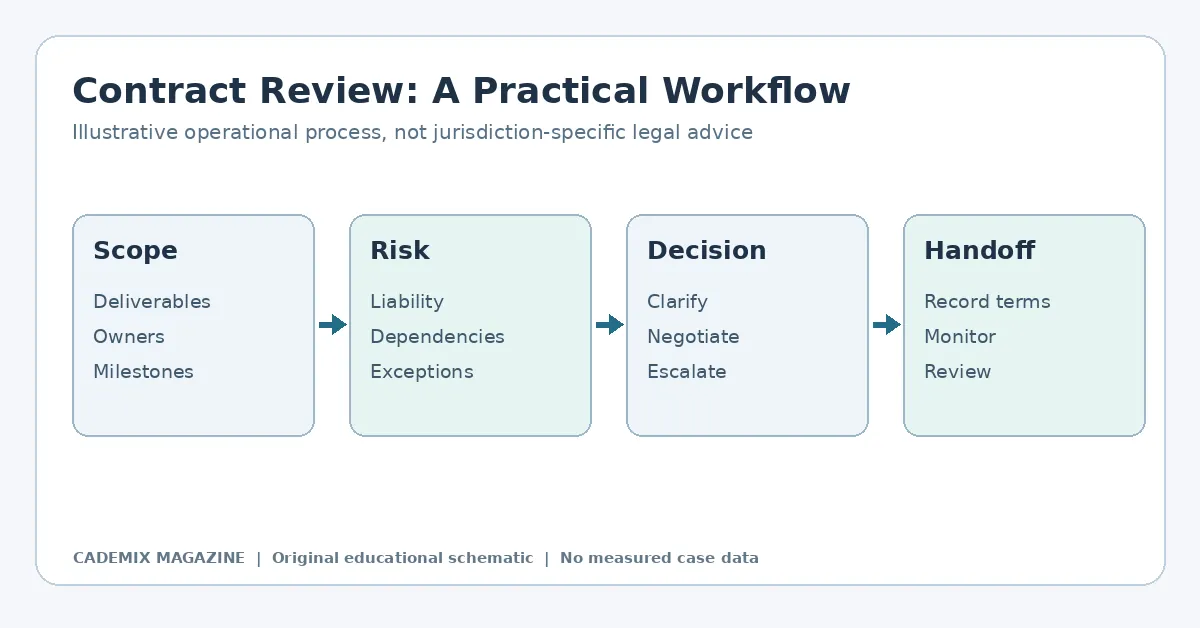
Table of Contents
- The Strategic Value of Contract Risk Review
- Core Competencies: The Triad of Skills
- 1. Legal Literacy Without Being a Lawyer
- 2. Financial Fluency and Quantification
- 3. Operational Pragmatism
- Building a Portfolio Evidence: From Theory to Practice
- Methodology for Hypothetical Case Studies
- Example Project: The Vendor Agreement Audit
- Professional Development Routes
- Academic Foundations
- Certifications and Specialized Training
- Mentorship and Networking
- Employer Expectations and Industry Nuances
- Real Estate and Property Management
- Finance and Investment
- Technology and SaaS
- Caveats and Challenges
- Conclusion: The Path Forward
- Further reading: Contract Management Specialist Through Business
- External reference for further study

In the modern corporate landscape, the contract is no longer merely a legal formality tucked away in a filing cabinet. It has evolved into a dynamic financial instrument, a risk management tool, and a strategic asset that dictates cash flow, operational continuity, and liability exposure. For students, graduates, and early-career professionals seeking a niche with high employability and intellectual rigor, the role of the Contract Management Specialist (CMS) offers a compelling career pathway. This role sits at the intersection of law, finance, and operations, requiring a unique blend of analytical precision and commercial acumen.
While many aspiring professionals gravitate toward traditional legal or accounting roles, the specific discipline of business contract risk review provides a distinct entry point into this specialized field. This article explores how mastering the art of identifying, quantifying, and mitigating contractual risks can serve as the foundation for a successful career as a Contract Management Specialist. We will examine the requisite skills, the construction of a professional portfolio, viable development routes, and the evolving expectations of employers in sectors ranging from real estate to fintech.
The Strategic Value of Contract Risk Review
To understand the career trajectory, one must first appreciate the function. A Contract Management Specialist does not simply store documents; they manage the lifecycle of agreements to ensure value realization and compliance. Central to this lifecycle is the pre-execution phase: the risk review.
When a company enters into a partnership, leases property, hires vendors, or secures financing, it assumes obligations and rights defined by text. A superficial reading might confirm that terms are “standard,” but a specialist’s job is to uncover the hidden liabilities. In the context of finance and real estate, these risks are often quantifiable. A poorly drafted indemnity clause in a commercial lease, for example, could expose a tenant to unlimited liability for structural failures caused by third parties. Similarly, in investment vehicles, ambiguous definitions of “net income” or “distributable cash” can lead to significant disputes over profit sharing.
Therefore, the ability to conduct a rigorous business contract risk review is not just a technical skill; it is a demonstration of commercial awareness. Employers view candidates who can articulate why a clause is risky, rather than just that it exists, as individuals capable of protecting the organization’s bottom line. This mindset—shifting from passive document handling to active risk mitigation—is the hallmark of a competent CMS.
Core Competencies: The Triad of Skills
Becoming a specialist requires more than a degree in law or business administration. It demands a triad of competencies: legal literacy, financial fluency, and operational pragmatism.
1. Legal Literacy Without Being a Lawyer
Contract management specialists are not necessarily licensed legal professionals; they should understand the business implications of common clauses and know when to obtain appropriately qualified legal guidance. This includes knowledge of offer and acceptance, consideration, breach, remedies, and force majeure. Crucially, the specialist must understand jurisdictional nuances. A contract governed by New York law differs significantly from one governed by English Common Law or Civil Code jurisdictions prevalent in parts of Europe and Latin America.
The key skill here is clause interpretation. Can you distinguish between a “best efforts” obligation and a “reasonable efforts” obligation? Do you understand the implications of an “entire agreement” clause on prior negotiations? These distinctions determine whether a dispute ends in litigation or settlement. For students, this means moving beyond memorizing statutes to analyzing case studies where wording determined outcomes.
2. Financial Fluency and Quantification
This is where the career path diverges from pure paralegal work. A CMS must translate legal terms into financial impacts. If a vendor fails to deliver goods on time, what is the cost of delay? Does the contract include liquidated damages, and if so, are they enforceable and sufficient to cover actual losses?
In real estate and investment contexts, this involves understanding amortization schedules, interest rate swaps, and capital expenditure commitments. A specialist reviewing a loan agreement must identify covenants that could trigger default events, such as maintaining certain debt-to-equity ratios. The ability to model these scenarios—even roughly—demonstrates to employers that the candidate understands the economic reality behind the paper.
3. Operational Pragmatism
Contracts dictate workflows. A service level agreement (SLA) defines response times, uptime percentages, and reporting requirements. A CMS must assess whether these terms are operationally feasible for their own organization or the counterparty. If a contract mandates weekly audits that require resources the company does not have, the risk is not just legal non-compliance but operational failure.
This skill set requires empathy for both the legal team (who want protection) and the operations team (who need flexibility). The specialist acts as a translator, ensuring that the contract reflects what the business actually intends to do, not just what the lawyers think it should say.
Building a Portfolio Evidence: From Theory to Practice
For graduates and job seekers, the challenge is proving these competencies without having held the title. Traditional resumes list duties; portfolios demonstrate capability. Since confidentiality prevents sharing real client contracts, candidates must create hypothetical projects that mirror industry standards.
Methodology for Hypothetical Case Studies
A strong portfolio piece involves taking a publicly available template or a synthesized scenario and conducting a full risk review. Here is a proposed methodology for creating such evidence:
- Select a Sector-Specific Scenario: Choose a realistic context, such as a mid-sized tech firm leasing office space in a major metropolitan area, or a private equity fund investing in a renewable energy startup.
- Draft or Source a Mock Contract: Create a 5–10 page agreement containing deliberate ambiguities, unfavorable terms, and missing protections. Alternatively, use open-source legal templates and modify them to introduce complexity.
- Conduct the Risk Review: Produce a memo addressed to a fictional General Counsel or CFO. This memo should not just list issues but categorize them by severity (High, Medium, Low) and propose specific redlines.
- Quantify the Impact: Where possible, attach a simple spreadsheet modeling the financial impact of the identified risks. For example, if the lease lacks a rent abatement clause during construction delays, calculate the potential loss based on average market rents.
Example Project: The Vendor Agreement Audit
Consider a hypothetical project titled “Risk Assessment of IT Service Provider Agreement.”
- Context: A retail chain is outsourcing its cloud infrastructure maintenance.
- Identified Risks:
- Data Ownership: The contract states the provider owns all metadata generated during service. Risk: Loss of customer insights and potential regulatory violation under GDPR/CCPA. Mitigation: Redline to clarify that raw data remains client property; derived analytics may be shared only in aggregate/anonymized form.
- Termination for Convenience: The provider can terminate with 30 days’ notice. Risk: Operational disruption and migration costs exceeding $500k. Mitigation: Negotiate a minimum term of 12 months or require transition assistance services included in the base fee.
- Liability Cap: Capped at fees paid in the last 3 months. Risk: Insufficient coverage for a data breach costing millions. Mitigation: Increase cap to 12 months’ fees or exclude data breaches from the cap entirely.
- Deliverable: A two-page executive summary highlighting the top three financial exposures and a marked-up contract showing suggested changes.
This type of artifact demonstrates critical thinking, attention to detail, and business orientation—qualities highly valued by hiring managers.
Professional Development Routes
There is no single university degree that guarantees a role as a Contract Management Specialist. Instead, the pathway is cumulative, combining formal education with targeted certifications and experiential learning.
Academic Foundations
Degrees in Law, Business Administration, Finance, or Real Estate are common starting points. However, coursework in contract drafting, commercial law, and financial modeling is particularly relevant. Students should seek electives that involve practical application, such as moot courts focused on commercial disputes or finance labs dealing with derivative instruments.
Certifications and Specialized Training
Professional bodies offer credentials that signal competence to employers. While specific names vary by region, look for certifications related to: * Contract Lifecycle Management (CLM): Understanding software tools like DocuSign CLM, Icertis, or Salesforce CPQ may be useful for certain employers but should not be described as a universal hiring requirement. Familiarity with these platforms shows readiness for digital transformation initiatives. * Project Management: PMP or PRINCE2 certifications help because contract management often overlaps with project delivery timelines. * Risk Management: Credentials from organizations specializing in enterprise risk can provide the quantitative framework needed for financial analysis.
It is crucial to note that certification alone is insufficient. It must be paired with practical experience. Many specialists start in procurement, legal support, or financial analysis before transitioning into dedicated contract management roles.
Mentorship and Networking
Because the field is interdisciplinary, networking across silos is vital. Attending conferences hosted by legal tech providers, real estate investment trusts (REITs), or supply chain associations can provide insight into current pain points. Engaging with mentors who have navigated the shift from generalist roles to specialist positions can offer guidance on which skills are currently in demand versus those that are becoming automated.
Employer Expectations and Industry Nuances
Employers in different sectors prioritize different aspects of contract risk review. Understanding these nuances allows job seekers to tailor their applications effectively.
Real Estate and Property Management
In this sector, the focus is heavily on compliance and long-term liability. Leases are long-dated instruments. Specialists are expected to scrutinize renewal options, rent escalation clauses, and maintenance responsibilities. There is also a growing emphasis on ESG (Environmental, Social, and Governance) criteria. Contracts must now reflect sustainability goals, such as energy efficiency standards or waste reduction commitments. A candidate who understands how to draft green lease clauses has a competitive advantage.
Finance and Investment
Here, the priority is counterparty risk and regulatory adherence. In banking and asset management, contracts are subject to intense scrutiny from regulators. Specialists must ensure that agreements comply with anti-money laundering (AML) laws, know-your-customer (KYC) requirements, and cross-border tax treaties. Speed is also critical; deals move fast, and the ability to perform rapid, accurate risk assessments without slowing down transaction velocity is highly prized.
Technology and SaaS
The tech industry emphasizes scalability and IP protection. With recurring revenue models, standardizing contracts is key. Specialists are expected to identify bottlenecks in negotiation processes and advocate for automation. Intellectual property rights regarding code ownership, user data privacy, and service availability (uptime SLAs) are the primary areas of concern. Proficiency in using AI-driven contract review tools to flag anomalies is becoming a baseline expectation.
Caveats and Challenges
Candidates must be aware of the limitations of the role. Contract management is often viewed as a cost center rather than a profit driver, which can limit budget allocation for training or technology. Furthermore, the rise of Generative AI poses a question mark on the future of routine review tasks. While AI can summarize clauses and flag deviations, it cannot yet fully replace the nuanced judgment required to negotiate complex trade-offs. Therefore, specialists must position themselves as strategists who leverage technology, not just reviewers who compete with it.
Another caveat is the emotional labor involved. Contract specialists often sit between aggressive sales teams (who want to close deals quickly) and conservative legal teams (who want to minimize risk). Navigating this tension requires strong soft skills, including negotiation, persuasion, and conflict resolution.
Conclusion: The Path Forward
Becoming a Contract Management Specialist through the lens of business contract risk review is a career choice that rewards curiosity, precision, and commercial intelligence. It is not a path for those who prefer rote memorization or isolated academic study. It is for those who enjoy solving puzzles where the pieces are words, numbers, and human behaviors.
For students and graduates, the roadmap is clear: build a foundation in legal and financial literacy, develop proficiency in digital contract tools, and create a portfolio that demonstrates your ability to protect value. Start small. Analyze public contracts. Model the risks. Write the memos. Show potential employers that you do not just read contracts—you interrogate them.
As businesses face increasing volatility in global markets, the demand for professionals who can secure stability through well-managed agreements will only grow. By focusing on the critical task of risk review, you position yourself not merely as an administrator of paperwork, but as a guardian of organizational integrity and financial health. This distinction is what separates a job seeker from a career specialist.
External reference for further study
General introduction to the EU legal framework; not a substitute for examining the applicable law. See European Commission — EU Law. This reference is a starting point, not a citation validating every claim in this article.
Building a Contract Risk Review Portfolio
A contract management specialist can demonstrate professional competence without presenting confidential client documents. Begin with a fictional procurement scenario and write a short scope statement covering deliverables, deadlines, acceptance criteria and operational dependencies. Then build a checklist that identifies what must be clarified before execution: responsibilities, change requests, information security, payment milestones, performance reporting, termination steps and the route for escalating disputes. Clearly distinguish the operational questions you can review from legal interpretations that require the appropriate qualified specialist.
Use two versions of a hypothetical agreement to show how ambiguity changes operational risk. In the first version, suppose a supplier promises to deliver a working system without defining a test procedure. In the revised version, specify a reasonable acceptance test, the party responsible for access to test systems and how incomplete requirements will be handled. The comparison need not include invented loss statistics. A recruiter can examine the quality of your reasoning, documentation and negotiation preparation without being told that fictitious savings were actually achieved.
For each risk, describe the assumed event, possible operational consequence, available evidence and responsible decision-maker. A rating matrix is a communication aid, not an objective forecast of the probability of litigation or loss. Do not convert a qualitative rating into a monetary amount unless the estimate is supported by current data and clearly defined assumptions. An effective contract management review should explain unresolved questions instead of presenting a colored score as a definitive legal conclusion.
Operational Review and Legal Escalation
A contract management professional often supports a cross-functional review that includes technical staff, purchasing, finance and appropriately qualified legal advisers where necessary. Their task is to organize requirements, make dependencies visible and record decisions. Employment, consumer, public procurement and data protection rules can differ by jurisdiction, and organizations should not assume that a clause used in one contract is legally effective elsewhere. Avoid presenting a template as universally enforceable across the European Union.
When a disagreement arises, the contract manager can establish the facts: which deliverable was accepted, what communications were recorded, which change request was approved and which obligations remain disputed. A clearly maintained chronology helps the authorized decision-maker decide whether further negotiation or specialist assessment is needed. It is not the role of an unlicensed specialist to guarantee a legal outcome or give jurisdiction-specific legal advice.
For general context on the European Union legal framework, consult the European Commission explanation of types of EU law. The presence of EU legislation does not resolve every contract dispute or replace the law applicable to a particular agreement. Candidates should verify current requirements and clearly identify which issues were addressed as operational risks rather than legal opinions.
Employer-Facing Evidence and Professional Development
Prepare a portfolio containing an anonymized or entirely fictional review checklist, a decision register and a short handover note. Include dates, document versions and any assumptions that might change the review. Demonstrate that you can explain a risk to both technical and nontechnical colleagues, track an action owner and follow up without promising results outside your authority. These habits are relevant in projects where contracts continue to evolve after signature.
In interviews, expect practical questions about unclear acceptance requirements, vendor delays, missing attachments or disagreement between commercial and technical stakeholders. Explain what you would ask, which documents you would compare and when you would escalate. A credible specialist does not need to know every answer from memory; the ability to recognize uncertainty and retrieve reliable records can be more important than claiming complete knowledge of contract law.